 Tunisia
Strategic note period
2022-2025
Other resources (non-core)
Country Indexes
UN Women in action: Strategic insights and achievements
View annual report narratives for the year
Advancing SDGs: UN Women's impact and key achievements
In 2025, women’s access to decent employment in STEM fields improved in Tunisia, with over 40 per cent of young women participating in the “Women & Youth in STEM Employment” (WYSE) initiative, implemented by UN Women, securing paid STEM jobs within three months. Through WYSE, more than 100 young women, including from underserved and interior regions, transitioned from education to work in STEM sectors, marking a critical step in closing the gap between women’s high educational attainment and their access to quality, private-sector employment.
For the participating young women, access to paid STEM employment has strengthened economic security, professional confidence, and long-term career prospects. This outcome is particularly significant in the Tunisian context, where women represent approximately 58 per cent of STEM graduates, ranking Tunisia among the first countries globally, and 66 per cent of higher education students generally.[1] Yet, women continue to face barriers in accessing employment: only 27.9 per cent of women are economically active, and women’s unemployment stands at 21.3 per cent, compared to 13.6 per cent for men, rising sharply to around 37.8 per cent among young women aged 15-24.[2]
Through strategic partnerships with private-sector actors and development partners, including the Embassy of the Netherlands, the Challenge Fund for Youth Employment, relevant national institutions, and leading companies such as the Orange Foundation, UN Women Tunisia expanded pathways to decent work for women while helping to shift perceptions around women’s participation in traditionally male-dominated sectors. These partnerships enabled targeted skills development, mentorship, and employer engagement, directly connecting women to private-sector opportunities through a national job fair and tailored recruitment pathways. Beyond immediate employment outcomes, the initiative generated positive spillover effects for younger girls aspiring to STEM careers, while contributing directly to SDG 5 (Gender Equality) and SDG 8 (Decent Work and Economic Growth).
[1] World Bank, 2025.
[2] National Institute of Statistics (INS), 2025.
For the participating young women, access to paid STEM employment has strengthened economic security, professional confidence, and long-term career prospects. This outcome is particularly significant in the Tunisian context, where women represent approximately 58 per cent of STEM graduates, ranking Tunisia among the first countries globally, and 66 per cent of higher education students generally.[1] Yet, women continue to face barriers in accessing employment: only 27.9 per cent of women are economically active, and women’s unemployment stands at 21.3 per cent, compared to 13.6 per cent for men, rising sharply to around 37.8 per cent among young women aged 15-24.[2]
Through strategic partnerships with private-sector actors and development partners, including the Embassy of the Netherlands, the Challenge Fund for Youth Employment, relevant national institutions, and leading companies such as the Orange Foundation, UN Women Tunisia expanded pathways to decent work for women while helping to shift perceptions around women’s participation in traditionally male-dominated sectors. These partnerships enabled targeted skills development, mentorship, and employer engagement, directly connecting women to private-sector opportunities through a national job fair and tailored recruitment pathways. Beyond immediate employment outcomes, the initiative generated positive spillover effects for younger girls aspiring to STEM careers, while contributing directly to SDG 5 (Gender Equality) and SDG 8 (Decent Work and Economic Growth).
[1] World Bank, 2025.
[2] National Institute of Statistics (INS), 2025.
Advancing SDGs: UN Women's impact and key achievements
Male parents are now better able to share care responsibilities with women thanks to the extension of paternity leave from 2 days to 7 days, with an additional 3 days for fathers of twins or children with health challenges, In fact, On July 31, 2024, Tunisia’s Parliament passed Law No. 2024-44, extending paternity leave. Fathers can now take leave flexibly within 30 days of their child’s birth, and the law applies equally to public- and private-sector employees, ensuring inclusivity. The reform also introduced longer maternity leave, prenatal leave, and postnatal leave for mothers of stillborn children, creating a supportive framework for families. By encouraging shared caregiving responsibilities, the law challenges traditional gender norms, enabling women to focus on career advancement while fostering equality within households. One of the key barriers to women’s career advancement is the unequal distribution of caregiving responsibilities, which disproportionately impacts their income, professional growth, and well-being. This reform is thus a landmark reform towards advancing gender equality and women’s economic empowerment, contributing to SDG 5 (Gender Equality) and SDG 8 (Decent Work and Economic Growth).
Contributing to this reform, lawmakers’ understanding of the benefits of expanded paternity leave improved due to UN Women’s pivotal technical inputs, evidence, and facilitation. Specifically, on July 12-13, 2024, 36 parliamentarians from critical commissions, including Defense, Security, Finance, and Human Rights, and international experts explored global best practices, particularly from the MENA region, and accessed evidence on the socioeconomic benefits of men’s caregiving. In this way, lawmakers accessed the necessary tools and recommendations to advocate for gender-responsive reforms. The timing of this intervention was critical, occurring as Parliament debated Bill 13/2024 on parental leave reforms. UN Women facilitated the workshop, creating a platform for informed decision-making, in partnership with Tunisia’s Parliament of the People’s Representatives (ARP).
Thus, recognizing the potential of paternity leave to shift traditional gender roles, UN Women played a pivotal role in addressing this structural inequality by supporting evidence-based policy discussions to promote shared caregiving responsibilities. UN Women’s expertise and strategic support ensured gender equality remained central to these discussions.
UN Women’s leadership was instrumental in this success, from convening stakeholders to providing technical expertise and fostering consensus. This initiative demonstrates how UN Women’s strategic interventions drive systemic change. The timely support not only advanced Tunisia’s legislative priorities but also laid the foundation for a societal shift toward gender equality, benefiting women, men, and families alike
Contributing to this reform, lawmakers’ understanding of the benefits of expanded paternity leave improved due to UN Women’s pivotal technical inputs, evidence, and facilitation. Specifically, on July 12-13, 2024, 36 parliamentarians from critical commissions, including Defense, Security, Finance, and Human Rights, and international experts explored global best practices, particularly from the MENA region, and accessed evidence on the socioeconomic benefits of men’s caregiving. In this way, lawmakers accessed the necessary tools and recommendations to advocate for gender-responsive reforms. The timing of this intervention was critical, occurring as Parliament debated Bill 13/2024 on parental leave reforms. UN Women facilitated the workshop, creating a platform for informed decision-making, in partnership with Tunisia’s Parliament of the People’s Representatives (ARP).
Thus, recognizing the potential of paternity leave to shift traditional gender roles, UN Women played a pivotal role in addressing this structural inequality by supporting evidence-based policy discussions to promote shared caregiving responsibilities. UN Women’s expertise and strategic support ensured gender equality remained central to these discussions.
UN Women’s leadership was instrumental in this success, from convening stakeholders to providing technical expertise and fostering consensus. This initiative demonstrates how UN Women’s strategic interventions drive systemic change. The timely support not only advanced Tunisia’s legislative priorities but also laid the foundation for a societal shift toward gender equality, benefiting women, men, and families alike
Advancing SDGs: UN Women's impact and key achievements
Institutions are increasingly creating effective and risk-sensitive public policies in partnership with economic and social actors, putting the country's resources at the service of inclusive, sustainable, resilient socio-economic development (UNSDCF Effect 1 and SDG 16.6). Related public policies started to focus on achieving the SDGs and on addressing socio-economic gaps as 12 key ministries started using the updated Balanced Scorecard on Gender (BSG) sheets in their Annual Performance Reports 2024 which allow the integration of gender into each ministries’ budget for the year. These ministries include the Ministry of Family, Women, Children, and Seniors; Ministry of Justice; Central GBO Unit - Ministry of Finance; Ministry of Social Affairs; Ministry of Higher Education; Ministry of Health; Ministry of Interior; Ministry of Tourism; Ministry of Defense; Ministry of Commerce; Ministry of Equipment; Ministry of Technologies of Communication. The achieve this result, 22 women and 12 men representatives of the 12 key ministries increased their capacities to design, create and implement Gender-Responsive Budgeting (GRB) tools – in particular the new GRB sheet- and Law 2017-58 on Ending Violence Against Women. To facilitate this learning, UN Women conducted workshops on the use of BSG sheets in Annual Performance Reports in March and in July. The Gender Budgeting Office (GBO) unit co organized the workshops and provided the BSG sheets.
UN Women's collaboration with the GBO Unit and 12 crucial ministries, including seven pilot ministries, exemplifies the synergies between normative support, UN-system coordination, and operational activities to combat violence. The strategic integration of Gender-Responsive Budgeting (GRB) tools and Law 2017-58 into the ministries' capacities is a joint effort towards a common goal. This aligns with UN Women's normative support by promoting gender-responsive legislation and integrating gender perspectives into national policies.
Efforts to address structural barriers to women’s empowerment and gender equality include ensuring that the national budget prioritizes meeting these needs. The utilization of Gender-Responsive Budgeting (GRB) tools holds the potential to catalyse structural changes benefiting women and girls in several ways. By integrating GRB into budgetary processes, governments can allocate resources more effectively towards gender equality initiatives, including healthcare, education, and social protection programs that directly impact women and girls. This strategic allocation of funds can help address systemic inequalities and barriers to access faced by women and girls, ultimately leading to improved outcomes in areas such as maternal health, girls' education, and economic empowerment. Furthermore, incorporating GRB into budget planning fosters transparency and accountability, ensuring that gender considerations are mainstreamed throughout decision-making processes.
UN Women's collaboration with the GBO Unit and 12 crucial ministries, including seven pilot ministries, exemplifies the synergies between normative support, UN-system coordination, and operational activities to combat violence. The strategic integration of Gender-Responsive Budgeting (GRB) tools and Law 2017-58 into the ministries' capacities is a joint effort towards a common goal. This aligns with UN Women's normative support by promoting gender-responsive legislation and integrating gender perspectives into national policies.
Efforts to address structural barriers to women’s empowerment and gender equality include ensuring that the national budget prioritizes meeting these needs. The utilization of Gender-Responsive Budgeting (GRB) tools holds the potential to catalyse structural changes benefiting women and girls in several ways. By integrating GRB into budgetary processes, governments can allocate resources more effectively towards gender equality initiatives, including healthcare, education, and social protection programs that directly impact women and girls. This strategic allocation of funds can help address systemic inequalities and barriers to access faced by women and girls, ultimately leading to improved outcomes in areas such as maternal health, girls' education, and economic empowerment. Furthermore, incorporating GRB into budget planning fosters transparency and accountability, ensuring that gender considerations are mainstreamed throughout decision-making processes.
Advancing SDGs: UN Women's impact and key achievements
Women and girls in Tunisia benefit from increased tools and information on online violence against women (OVAW), and increased awareness and commitment of decision-makers.
292 women and girls are now equipped with information and tools to combat online violence and assert their rights to participate in the online space. They were reached through a total of 14 trainings provided by 16 women who participated in a training of trainers (ToT) five (5) day workshop conducted in August. The trainers reported that they were able to conduct subsequent trainings thanks to their own improved knowledge and skills on combatting OVAW received in the ToT.
Stakeholders in Tunisia and Libya have greater awareness of the challenges and opportunities to address OVAW, following the participation of 65 activists and representatives from civil society, public institutions and the international community at a seminar hosted by UN Women as part of the 16 Days Campaign 2022. Throughout the 16 Days of Activism against Gender-Based Violence, eight (8) CSOs and independent advocates, convened and covered on social media by UN Women, implemented an advocacy campaign focusing on service delivery.
An action plan to end OVAW was developed by representatives of nine (9) authorities (6 women and 3 men), including representatives from the Ministry of Interior and the National Agency on Computer Security and experts in the areas of law, cyber-crime, and sociology. The action plan contains five (5) agreed outputs and 14 actions to protect women from online violence. It takes into account the priorities identified during the roundtable mentioned above that UN Women shared with the participants. UN Women also provided a strategic planning expert.
These results were based on priority interventions to combat OVAW agreed upon in a multi-stakeholder roundtable discussion held in May, with representatives of public institutions and civil society, including from the LGBTIQ+ community and people with disabilities. Among them were 24 young women. Those priorities include working on improving the legal framework and services and influencing social norms that provoke OVAW.
[SDG 5, targets 5.2, 5.5 and 5.B; UNSDCF Outcome 2]
292 women and girls are now equipped with information and tools to combat online violence and assert their rights to participate in the online space. They were reached through a total of 14 trainings provided by 16 women who participated in a training of trainers (ToT) five (5) day workshop conducted in August. The trainers reported that they were able to conduct subsequent trainings thanks to their own improved knowledge and skills on combatting OVAW received in the ToT.
Stakeholders in Tunisia and Libya have greater awareness of the challenges and opportunities to address OVAW, following the participation of 65 activists and representatives from civil society, public institutions and the international community at a seminar hosted by UN Women as part of the 16 Days Campaign 2022. Throughout the 16 Days of Activism against Gender-Based Violence, eight (8) CSOs and independent advocates, convened and covered on social media by UN Women, implemented an advocacy campaign focusing on service delivery.
An action plan to end OVAW was developed by representatives of nine (9) authorities (6 women and 3 men), including representatives from the Ministry of Interior and the National Agency on Computer Security and experts in the areas of law, cyber-crime, and sociology. The action plan contains five (5) agreed outputs and 14 actions to protect women from online violence. It takes into account the priorities identified during the roundtable mentioned above that UN Women shared with the participants. UN Women also provided a strategic planning expert.
These results were based on priority interventions to combat OVAW agreed upon in a multi-stakeholder roundtable discussion held in May, with representatives of public institutions and civil society, including from the LGBTIQ+ community and people with disabilities. Among them were 24 young women. Those priorities include working on improving the legal framework and services and influencing social norms that provoke OVAW.
[SDG 5, targets 5.2, 5.5 and 5.B; UNSDCF Outcome 2]
Results and resources
- Results overview
- Total resources
- Development results and resources
- Organizational results and resources
Budget
Expenses
Outcome
Result statement
IATI identifier
Budget
Expenses
Outcome
Result statement
IATI identifier
OutcomeTUN_O_1
Outcome result statementUN Women is an accountable and trustworthy development organization that manages its financial and other resources with integrity and in line with its programmatic ambitions and fiduciary obligations.
IATI identifierXM-DAC-41146-TUN_O_1
OutcomeTUN_O_2
Outcome result statementUN Women effectively leverages and expands its partnerships, communications and advocacy capabilities to increase support for and financing of the gender equality agenda, while securing sustainable resourcing for the delivery of its own mandate.
IATI identifierXM-DAC-41146-TUN_O_2
OutcomeTUN_O_3
Outcome result statementUN Women strategically plans for and transforms its business model to deliver impact at scale, through agile and ethical leadership rooted in a continuous improvement culture.
IATI identifierXM-DAC-41146-TUN_O_3
OutcomeTUN_O_4
Outcome result statementWith its unique and inclusive culture, UN-Women is an employer of choice with a diverse and highly performing cadre of personnel that embodies UN values.
IATI identifierXM-DAC-41146-TUN_O_4
OutcomeTUN_O_5
Outcome result statementUN Women efficiently and effectively discharges of all business processes that advance integrated delivery of its normative, operational and coordination mandate at HQ, Regional and Country level, including through shared services.
IATI identifierXM-DAC-41146-TUN_O_5
Resources allocated towards SDGs
View SDG data for
Our funding partners contributions
- Chart
- Table
Regular resources (core)
$0.00 in total
Lorem Ipsum is simply dummy text of the printing and typesetting industry.
Other resources (non-core)
$2.92 M in total
Other resources (non-core)
$2.92 M in total
Lorem Ipsum is simply dummy text of the printing and typesetting industry.
| 2023 | 2022 | |
|---|---|---|
| Finland | $329,284 2023
FinlandOECD-DAC donor
Total contribution:$329,284
Development:$329,284(100%)
Humanitarian:$0(0%)
|
$329,284 2022
FinlandOECD-DAC donor
Total contribution:$329,284
Development:$329,284(100%)
Humanitarian:$0(0%)
|
| Japan | $168,882 2023
JapanOECD-DAC donor
Total contribution:$168,882
Development:$168,882(100%)
Humanitarian:$0(0%)
|
$168,882 2022
JapanOECD-DAC donor
Total contribution:$168,882
Development:$168,882(100%)
Humanitarian:$0(0%)
|
| Sweden | $109,564 2023
SwedenOECD-DAC donor
Total contribution:$109,564
Development:$109,564(100%)
Humanitarian:$0(0%)
|
$109,564 2022
SwedenOECD-DAC donor
Total contribution:$109,564
Development:$109,564(100%)
Humanitarian:$0(0%)
|
| Switzerland | $76,072 2023
SwitzerlandOECD-DAC donor
Total contribution:$76,072
Development:$76,072(100%)
Humanitarian:$0(0%)
|
$76,072 2022
SwitzerlandOECD-DAC donor
Total contribution:$76,072
Development:$76,072(100%)
Humanitarian:$0(0%)
|
| United Nations Multi-Partner Trust Fund Office | $401,986 2023
United Nations Multi-Partner Trust Fund OfficeUnited Nations pooled fund
Total contribution:$401,986
Development:$401,986(100%)
Humanitarian:$0(0%)
|
$401,986 2022
United Nations Multi-Partner Trust Fund OfficeUnited Nations pooled fund
Total contribution:$401,986
Development:$401,986(100%)
Humanitarian:$0(0%)
|
| United Nations Women as Administrative Agent for Joint Programmes | $372,751 2023
United Nations Women as Administrative Agent for Joint ProgrammesUnited Nations pooled fund
Total contribution:$372,751
Development:$372,751(100%)
Humanitarian:$0(0%)
|
$372,751 2022
United Nations Women as Administrative Agent for Joint ProgrammesUnited Nations pooled fund
Total contribution:$372,751
Development:$372,751(100%)
Humanitarian:$0(0%)
|
2023
Finland$329,284
Total contribution$329,284
Development$329,284(100%)
Humanitarian$0(0%)
Japan$168,882
Total contribution$168,882
Development$168,882(100%)
Humanitarian$0(0%)
Sweden$109,564
Total contribution$109,564
Development$109,564(100%)
Humanitarian$0(0%)
Switzerland$76,072
Total contribution$76,072
Development$76,072(100%)
Humanitarian$0(0%)
United Nations Multi-Partner Trust Fund Office$401,986
Total contribution$401,986
Development$401,986(100%)
Humanitarian$0(0%)
United Nations Women as Administrative Agent for Joint Programmes$372,751
Total contribution$372,751
Development$372,751(100%)
Humanitarian$0(0%)
2022
Finland$329,284
Total contribution$329,284
Development$329,284(100%)
Humanitarian$0(0%)
Japan$168,882
Total contribution$168,882
Development$168,882(100%)
Humanitarian$0(0%)
Sweden$109,564
Total contribution$109,564
Development$109,564(100%)
Humanitarian$0(0%)
Switzerland$76,072
Total contribution$76,072
Development$76,072(100%)
Humanitarian$0(0%)
United Nations Multi-Partner Trust Fund Office$401,986
Total contribution$401,986
Development$401,986(100%)
Humanitarian$0(0%)
United Nations Women as Administrative Agent for Joint Programmes$372,751
Total contribution$372,751
Development$372,751(100%)
Humanitarian$0(0%)
Strategic plan contributions
- Impact areas
- Systemic outcomes
- Organizational output
Documents
Tunisia: Strategic note 2022–2025 brochure
22 May 2025Results stories
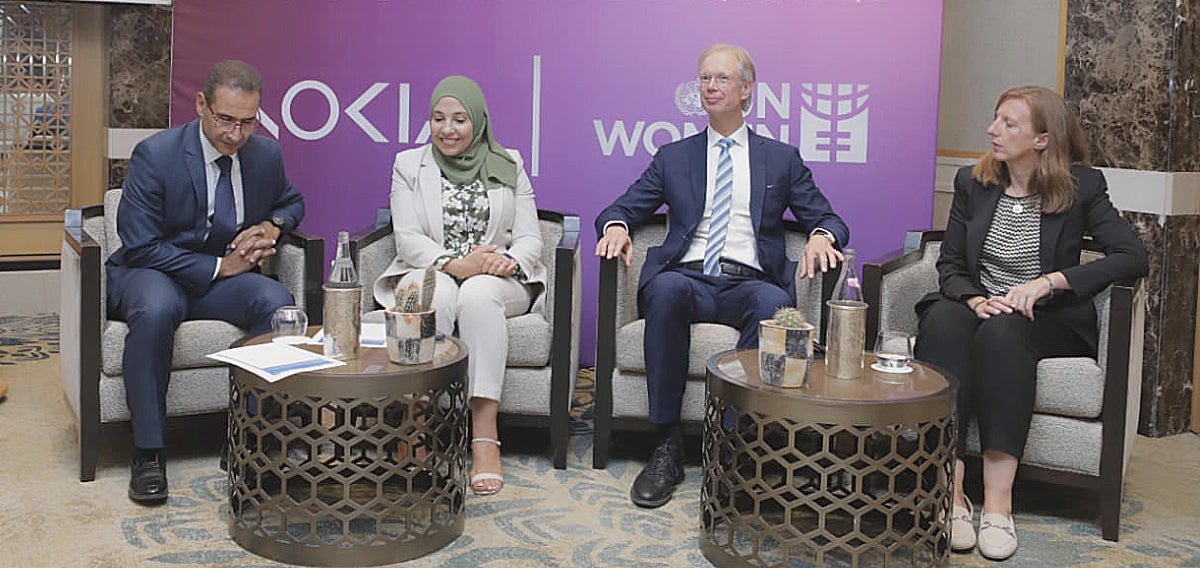
UN Women Tunisia and Nokia convene stakeholders to advocate for technology-driven solutions to combat violence against women
26 September 2024