UN Women Transparency Portal
Photo: UN Women/Johis Alarcón
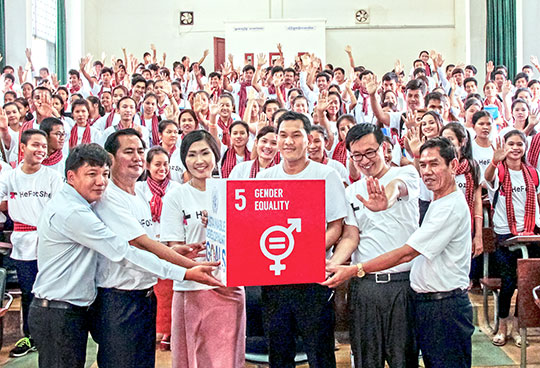
Global results
Explore global results from UN Women’s Strategic Plans. Learn more about the entity’s contributions to gender equality and women’s empowerment and the achievement of all 17 Sustainable Development Goals.
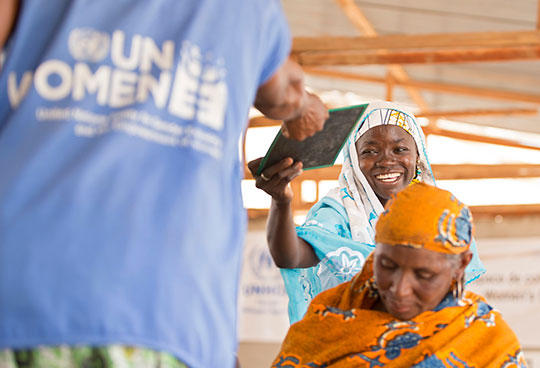
Country results
Delve into field-based results achieved by UN Women directly and with its implementing partners, including government entities, non-governmental organizations, United Nations organizations and other intergovernmental institutions.
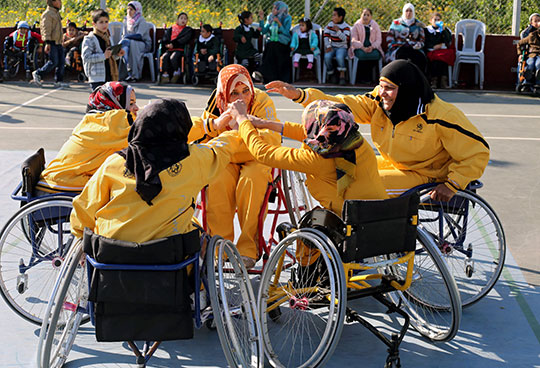
Funding partners
Find out about funding partners and see how they enable UN Women to carry out its mandate as the global champion, convenor and catalyst for gender equality and women’s empowerment.
2030 Agenda
Learn about how UN Women is contributing to the Sustainable Development Goals, realizing the principle of leaving no one behind.
Making an impact
UN Women worked in 135 countries and territories from 2022-2025 to achieve the following results
across 110 countries now have a more supportive legislative and policy environment protecting their rights following UN-Women's successful collaboration with national partners

were adopted, revised or repealed to further advance and protect the rights of women and girls, in line with international norms and standards, including 99 on women’s economic empowerment and 21 on women’s political participation
across 100 countries have strengthened capacities to deliver quality goods, services, and resources for women across the humanitarian-development-peace continuum
adopted 732 gender-responsive national and local multi-sectoral policies, strategies and plans, addressing issues such as equal pay, the care economy, violence against women, the environment and climate change, and women, peace and security, potentially benefitting 2.9 billion women and girls
disbursed to civil society organizations, local women-led organizations and networks as the backbone of open and democratic societies, and inclusive humanitarian responses and peacebuilding processes
were established to enable the meaningful and safe participation in decision-making of women and over 10,300 civil society organizations have strengthened leadership capacities across 128 countries
accessed services, goods, resources and/or information, including 7.4 million in humanitarian and crisis settings, in close partnership with the United Nations system, national actors and women-led organizations
adopted strategies for the prevention of violence against women for the first time, strengthening protection for nearly 1.3 billion women and girls – these efforts are leading progress on SDG indicators 5.2.1 and 5.2.2 to reduce the proportion of women and girls subjected to physical, sexual or psychological violence
are expected to benefit from 36 newly adopted women, peace and security national action plans with monitoring indicators, bringing the total to 117 countries and territories that are implementing plans to prevent and reduce the devastating impacts of conflict on communities
since 2021 in the number of United Nations country teams that reported on the UNCT-SWAP, strengthening the accountability of the United Nations system to women and girls
in the number of private companies that have committed to fostering business practices that empower women through adoption of the Women’s Empowerment Principles
across 83 countries now have a more supportive legislative and policy environment protecting their rights following UN-Women's successful collaboration with national partners.
were adopted, revised or repealed to further advance and protect the rights of women and girls, in line with international norms and standards.
across 95 countries with strengthened capacities to deliver quality goods, services, and resources for women across the humanitarian-development-peace continuum.
adopted 490 gender-responsive national and local multi-sectoral policies, strategies and plans, addressing issues such as equal pay, the economy of care, violence against women, environment and climate change, and women, peace and security, potentially benefitting 2.7 billion women and girls.
have been disbursed to civil society organizations, local women-led organizations and networks, working towards the achievement of gender equality, including in conflict and crisis settings.
- such as dialogues or coalitions - have been established in in 44 countries to enable the meaningful and safe engagement of civil society representatives in policy design and decision-making.
have adopted strategies for the prevention of violence against women. These efforts are leading progress towards SDG(Sustainable Development Goal) indicators 5.2 and 5.2.2 to reduce the proportion of women and girls subjected to physical, sexual or psychological violence.
- including entire communities - stand to gain from inclusive efforts to prevent conflict, build sustainable peace and reduce the devastating impacts of violence on their lives and communities, as outlined in the 18 new national action plans on women, peace and security adopted since 2021.
in the number of United Nations Country Teams who reported on the UNCT-SWAP(System-wide Action Plan) - strengthening accountability of the UN system to women and girls.
(137% increase since 2021) have now committed to fostering business practices that empower women through the Women’s Empowerment Principles.

national and local multi-sectoral policies, strategies and/or plans were adopted in 58 countries, with the potential to benefit 2.6 billion women and girls
in 82 countries have increased capacities to influence gender-responsive legislation, strategies, policies, action plans and/or institutional reforms
have a process to design and implement Violence Against Women (VAW) prevention strategies, or with VAW prevention interventions based on global norms and standards
across 79 countries, including many survivors of violence and internally-displaced women and refugees, accessed information, goods, resources and/or services with support from UN Women
across 87 countries have enhanced capacities to deliver and/or monitor essential services, goods and resources for women and girls in humanitarian and development settings
or mechanisms, across 84 countries, enhanced leadership capacity and enabled meaningful and safe engagement in decision-making

UN Women worked to ensure statistical systems do not turn a blind eye to women, supporting
76 gender statistics/data initiatives to inform policy, programming and budgeting and/or develop national plans and strategies, and 31 countries used the data for policies and programmes
that developed Cooperation Frameworks in 2023 prioritized gender equality (72 per cent in 2022) with UN Women’s support
adopted by the General Assembly, the Security Council, and the Human Rights Council integrated a gender perspective
advanced gender-responsive fiscal laws, policies, budgets, and systems
advanced policies to end violence against women and girls, with a strong focus on prevention including addressing harmful social gender norms
across 30 countries supported to participate in humanitarian coordination and decision-making processes
collection initiatives were implemented
across six regions adopted or amended to advance gender equality and women’s empowerment
were allocated to projects supporting gender equality and women’s empowerment
Documents
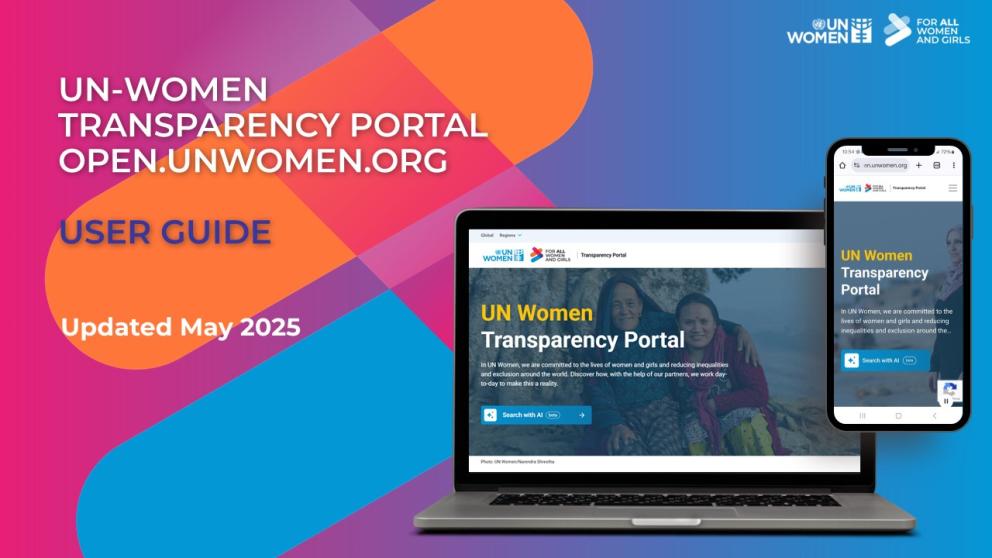
Transparency Portal user guide
12 May 2025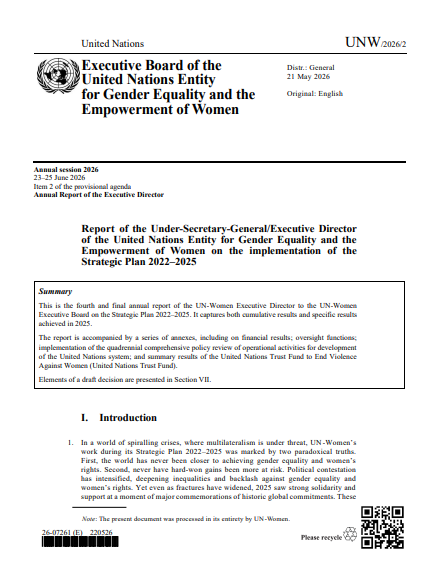
Executive Director’s Annual Reports 2022–2025
22 July 2026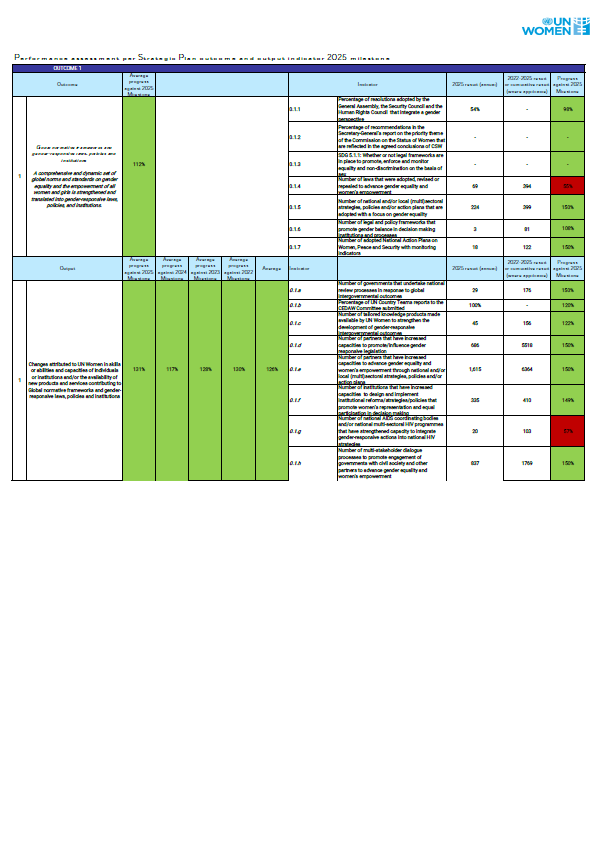
2025 performance assessment table
03 June 2026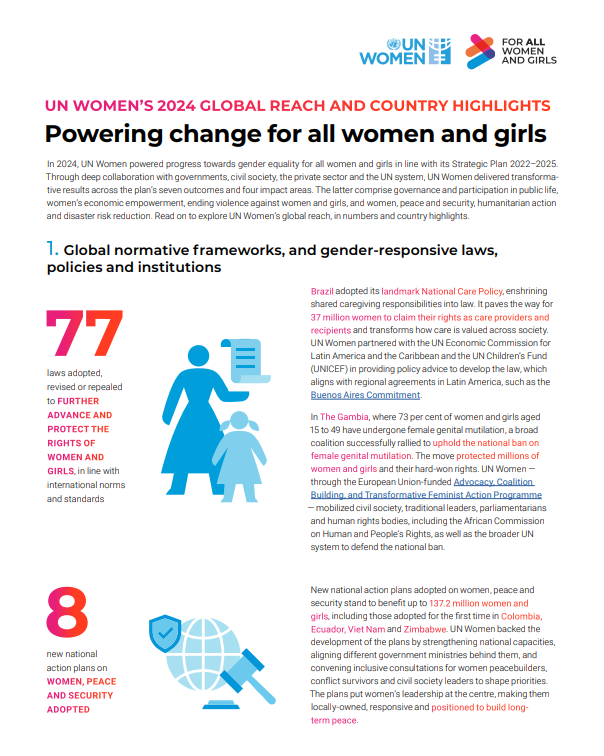
Global reach and country highlights 2024
10 September 2025
Regular resources report 2024: UN Women’s impact through regular resources
07 November 2025