From Opportunity to Impact: Advancing Women’s Economic Empowerment in Bolivia
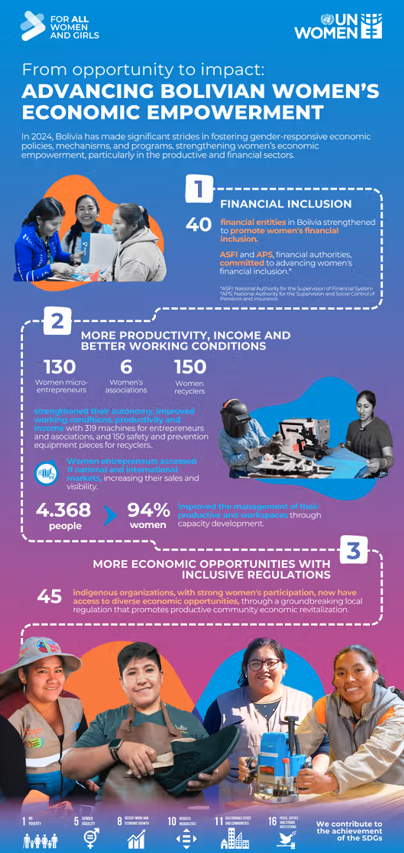 In 2024, Bolivia made significant progress in promoting gender-focused policies, mechanisms, and economic initiatives, contributing to women's economic empowerment and reducing inequalities, particularly in the productive and financial sectors (SDG 5, SDG 8, and SDG 10). Through strategic partnerships with the Ministry of Productive Development and Plural Economy, financial regulators, such as the Financial System Supervisory Authority (ASFI) and the Pension and Insurance Supervisory and Social Control Authority (APS), BancoSol, and economic associations, gender perspective have been increasingly integrated into financial instruments, policies, and public-private initiatives. These efforts have led to tangible improvements in women's access to financial services and economic opportunities, contributing directly to inclusive economic growth and the achievement of SDG 8.
As part of these efforts, Bolivian financial regulators ASFI and APS have reaffirmed their commitment to advancing women's financial inclusion by promoting more equitable access to credit, savings, and financial services. A total of 40 financial institutions and development partners have strengthened their knowledge and tools to foster a more inclusive financial sector.
BancoSol, a member of the Alliance for Financial Inclusion, has established itself as a leader in gender-focused financial services by launching Bolivia's first Gender Social Bond. As part of the Women’s Empowerment Principles (WEPs) 2.0 Accelerator Program, this microfinance institution received specialized technical support from UN Women, enhancing its capacity for gender-responsive monitoring, reporting, and evaluation. This progress was globally recognized at the United Nations Environment Programme Finance Initiative (UNEP FI) meeting.
At the public policy level, the national and subnational governments, with technical assistance from UN Women, are developing comprehensive policies to ensure gender equity in unpaid domestic and care work (SDG 5 and SDG 10). These include:
- A National Care Policy to recognize and redistribute care responsibilities.
- A Social Reproduction Policy addressing unpaid and care work.
- Municipal care policies in Santa Cruz and El Alto, integrating localized strategies for care services.
Moreover, economic opportunities for women have expanded through targeted support programs implemented by UN Women with funding from the Korea International Cooperation Agency (KOICA). A total of 130 micro and small women-led enterprises now benefits from increased productivity and income thanks to the provision of machinery and equipment, while six institutions have received 111 essential equipment pieces to strengthen their operations. Through specialized training programs, 4,104 people (3,851 women) have enhanced their skills in business management and technical abilities, facilitating their access to sustainable economic opportunities (SDG 1, SDG 5, SDG 8, SDG 10).
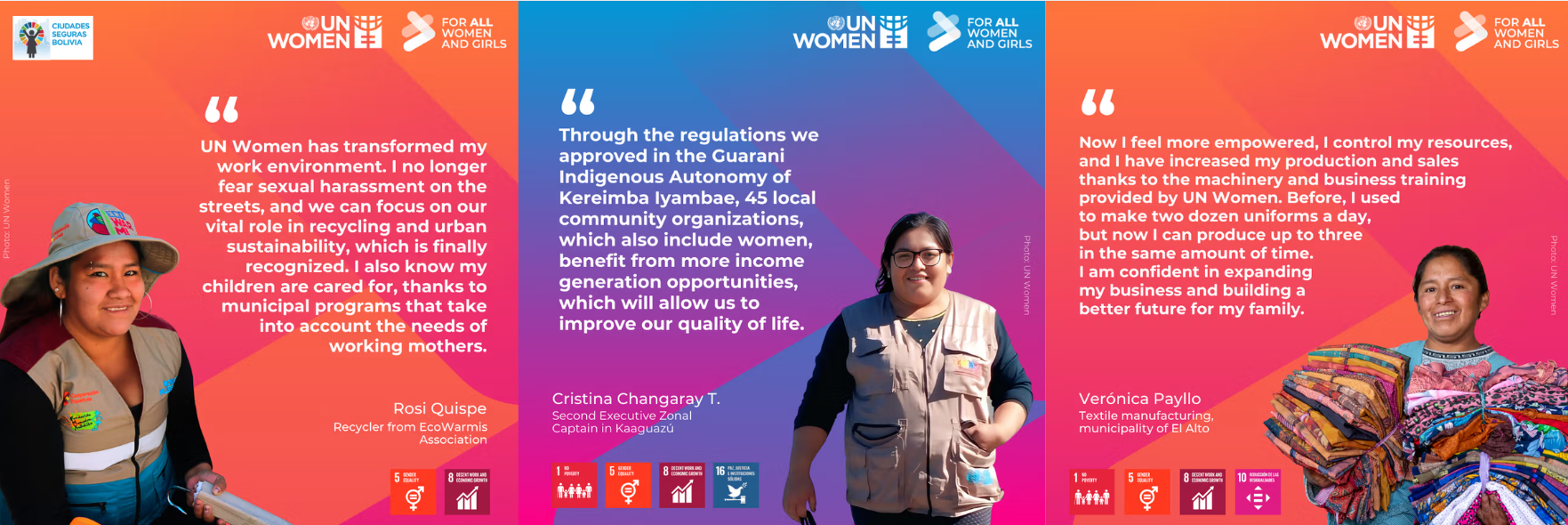
Additionally, leveraging a joint approach of the Ending Violence Against Women (EVAW) and Women’s Economic Empowerment programs, 150 women recyclers now work in safe conditions with access to protective equipment, while 264 women have strengthened their skills in gender-based violence prevention, waste management, and occupational health and safety. This initiative, funded by the Spanish Agency for International Development Cooperation (AECID), has contributed to greater economic autonomy for women in the recycling sector, improved their access to justice, and promoted safer, more sustainable working environments. (SDG 1, SDG 5, SDG 8, SDG 10 and SDG 11).
Furthermore, two autonomous Indigenous communities have advanced gender-responsive public procurement policies, with technical assistance of UN Women provided through the State Autonomies Service. As a result, the Guaraní Indigenous Autonomy of Kereimba Iyambae approved Regulation 64/2024, expanding opportunities for 45 community organizations, with significant participation from women, to access diverse income-generating alternatives. This milestone strengthens the livelihoods and economic resilience of Indigenous women, their families, and communities while aligning with the principles of parity and equity in economic participation (SDG 1, SDG 5, SDG 8, SDG 10, and SDG 16).
In an important move towards gender equality, UN Women Bolivia in recent collaboration with the United Nations Population Fund (UNFPA) in Bolivia, launched the #SíEsDeHombres campaign roughly translating to #YesItIsMen in English. This initiative targets adolescents, and young adults, urging them to rethink and redefine traditional gender roles. By deconstructing harmful stereotypes, the campaign aims to foster societies where equality is the norm, and everyone can fully exercise their rights.
The campaign also addresses the modern challenges of digital violence, such as the non-consensual dissemination of intimate images. By promoting the prevention of such acts, #SíEsDeHombres is taking a stand against all forms of violence, both offline and online. These messages are designed to inspire men to become advocates for change, promoting a culture of zero tolerance towards violence against women and girls.
The campaign plans to consolidate strategic alliances with networks of young people and students, particularly in the city of El Alto, Bolivia. This youth engagement is crucial for the prevention of sexual violence and the promotion of healthy, egalitarian relationships from a young age.
At the heart of #SíEsDeHombres is the concept of positive social norms. This involves daily actions that dismantle patriarchal and sexist norms, replacing them with behaviors that foster equality. The campaign seeks to eliminate traditional gender roles that create power imbalances and contribute to violence and discrimination.
About HeForShe
About UN Women
UN Women is the United Nations entity dedicated to gender equality and the empowerment of women. A global champion for women and girls, UN Women was established to accelerate progress on meeting their needs worldwide.
About the UNFPA:
The UNFPA is the United Nations sexual and reproductive health agency. Their mission is to deliver a world where every pregnancy is wanted, every childbirth is safe and every young person's potential is fulfilled.
Summary of country programme
UN Women’s Bolivia Strategic Note 2023-2027 seeks to advance gender equality and women's empowerment by addressing challenges such as gender-based violence, economic inequality and political underrepresentation. It integrates intersectionality to understand and address multiple forms of discrimination against women. Key locations include rural and Indigenous areas.
The programme prioritizes governance and political participation, economic empowerment, and the elimination of violence against women and girls. It emphasizes innovation and approaches such as capacity-building, social norms changes, policy advocacy and community engagement.
Major partnerships with government institutions, civil society organizations and international agencies as well as participation in UN joint programmes enhance effectiveness. Collaboration with entities including the Ministry of Justice and international donors aims to achieve significant outcomes, including improved legal frameworks and increased women's participation in decision-making. Strategic Note direct funding supports these initiatives.

Documents
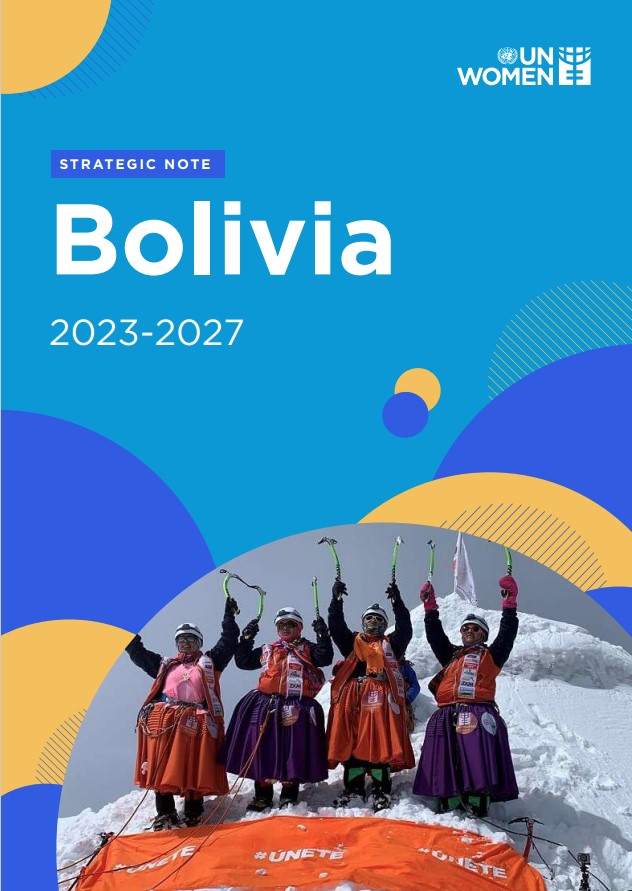
Bolivia: Strategic note 2023–2027 brochure
22 May 2025