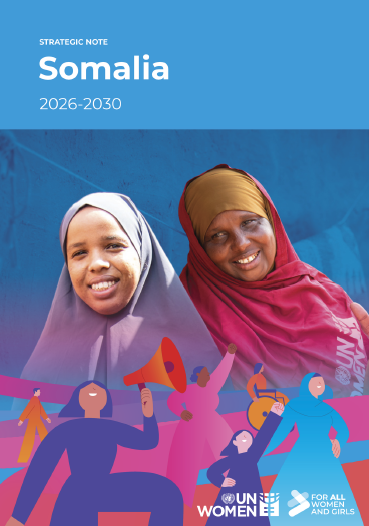
 Somalia
Strategic note period
2022-2025
Other resources (non-core)
Country Indexes
UN Women in action: Strategic insights and achievements
View annual report narratives for the year
Advancing SDGs: UN Women's impact and key achievements
The most significant result achieved was the advancement of gender-responsive legal and policy reforms that strengthened women’s political participation, protection from harmful practices, and access to justice, directly improving the lives of women and girls and contributing to SDGs 5, 10, and 16.
Through Women, Peace and Protection Joint Programme, UN Women supported historic policy gains, including the adoption of a 30 per cent women’s quota in the Somalia’ Electoral Law, recognised in 2025 as a major milestone for advancing women’s political participation. Women currently hold 19% of parliamentary seats (52 out of 274 MPs), reflecting progress yet still falling short of the 30% target. The Programme also contributed to landmark legal protections for girls through the first-ever legal bans on Female Genital Mutilation (FGM) in three Federal Member States (Jubaland, Galmudug and Southwest ). The outcomes were enabled through strong partnerships with the UN in Somalia, and civil society. The establishment of eight Women’s Parliamentary Caucuses that advanced gender-responsive legislation, amplified women’s leadership in peacebuilding, and a Civil Society Reference Group on Women, Peace and Security that led in coordinating a high-level advocacy contributed to the result.
Complementing these national and state -level reforms, UN Women-through the Somaliland National Human Rights Commission and under the UN Joint Rule of Law Programme (JRoLP) has supported gender-responsive justice reforms in Somaliland, A key outcome was UN Women’s technical support to the amendment of the Sexual Offences Bill, including the review and revision of 22 articles to enhance survivor protection and align the legislation with international human rights standards. The amended bill was submitted to the House of Elders (Guurti), reflecting growing political consensus and institutional commitment. The commission delivered free legal aids to nearly 1,500 people, over 70% were women and children. This progress was achieved through close partnerships with the Somaliland National Human Rights Commission (SLNHRC), the Technical Working Group, members of the House of Elders (Guurti) and UN family.
At the community and institutional levels, UN Women partnered with NAGAAD Network to engage 38 women religious scholars and 108 (F:70, M:38) community leaders in promoting gender-responsive justice and positive social norms, increasing public awareness of women’s rights. In collaboration with the Somaliland Women Lawyers Association (SWLA), UN Women strengthened survivor-centred justice t and organizing legal awareness sessions for 200 .Females:195, Male:5) participants to improve confidence in reporting GBV cases, UN Women also organized advocacy engagements with 0 (F:25, M:15) judiciary and Attorney General officials to promote gender-responsive policies and women’s representation in the justice sector.
Through Women, Peace and Protection Joint Programme, UN Women supported historic policy gains, including the adoption of a 30 per cent women’s quota in the Somalia’ Electoral Law, recognised in 2025 as a major milestone for advancing women’s political participation. Women currently hold 19% of parliamentary seats (52 out of 274 MPs), reflecting progress yet still falling short of the 30% target. The Programme also contributed to landmark legal protections for girls through the first-ever legal bans on Female Genital Mutilation (FGM) in three Federal Member States (Jubaland, Galmudug and Southwest ). The outcomes were enabled through strong partnerships with the UN in Somalia, and civil society. The establishment of eight Women’s Parliamentary Caucuses that advanced gender-responsive legislation, amplified women’s leadership in peacebuilding, and a Civil Society Reference Group on Women, Peace and Security that led in coordinating a high-level advocacy contributed to the result.
Complementing these national and state -level reforms, UN Women-through the Somaliland National Human Rights Commission and under the UN Joint Rule of Law Programme (JRoLP) has supported gender-responsive justice reforms in Somaliland, A key outcome was UN Women’s technical support to the amendment of the Sexual Offences Bill, including the review and revision of 22 articles to enhance survivor protection and align the legislation with international human rights standards. The amended bill was submitted to the House of Elders (Guurti), reflecting growing political consensus and institutional commitment. The commission delivered free legal aids to nearly 1,500 people, over 70% were women and children. This progress was achieved through close partnerships with the Somaliland National Human Rights Commission (SLNHRC), the Technical Working Group, members of the House of Elders (Guurti) and UN family.
At the community and institutional levels, UN Women partnered with NAGAAD Network to engage 38 women religious scholars and 108 (F:70, M:38) community leaders in promoting gender-responsive justice and positive social norms, increasing public awareness of women’s rights. In collaboration with the Somaliland Women Lawyers Association (SWLA), UN Women strengthened survivor-centred justice t and organizing legal awareness sessions for 200 .Females:195, Male:5) participants to improve confidence in reporting GBV cases, UN Women also organized advocacy engagements with 0 (F:25, M:15) judiciary and Attorney General officials to promote gender-responsive policies and women’s representation in the justice sector.
Advancing SDGs: UN Women's impact and key achievements
The Electoral Law was amended in November 2024, securing 30% of women’s quota for the first time in Somalia. The Women Parliamentary Caucuses (WPC) in the national parliament (Upper House and House of the People) and the Parliaments of the five Federal Member States were among the most influential advocacy groups in the country to secure 30% women’s quota in the Electoral Law. The Caucuses aim to increase women's impact on political decisions by providing the necessary support to promote a gender equality legislative and policy agenda, including Somalia's ongoing constitutional review process. The WPCs were established in 2023 and 2024 through UN Women technical and financial support under the UN Joint Program “Women, Peace and Protection (WPP)” implemented with UNDP and UNSOM. More specifically, UN Women supported the WPCs through facilitating knowledge exchange to; 1) provide overview of the proposed electoral systems in the draft electoral law and share examples of successful temporary special measures (TSM) being exercised in neighboring countries to promote women’s political participation; and 2) provide a platform for collaborative brainstorming to develop strategies for gaining political support for incorporating TSM in the election related laws to achieve 30% women representation at District, State, and Federal levels. In addition, UN Women and UNDP organized a study visit for WPC Delegates to Rwanda to gain perspective on gender parity in the Parliament, which renewed the commitment of the delegates to advocate for the inclusion of 30% women quota in the Constitution. As a follow-up to the visit, the Somali delegation is also looking into replicating the GBV One Stop Centers, implementing Gender Responsive Budgeting, and promoting women’s socio-economic development.
Advancing SDGs: UN Women's impact and key achievements
UN Women in its role as a Co-Chair of the UN Gender Theme Group, UNCF Results Group on Gender, Human Rights, and Inclusion undertakes regular review and advocacy with the UN entities in Somalia in integration and mainstreaming of gender aligned to the UNCF as well as the global norms and standards including the realization of SDGs. Through UN Women and the DSRSG/RC/HC advocacy, the GTG is supported by the UNCT in initiating the “UNCT SWAP Gender Score Card Exercise for greater accountability on GEWE commitments’ and extended unwavering support for allocation of cost shared pooled resources. During the reporting period, the UN Women Humanitarian intervention n in the country has reached the most vulnerable and marginalized women living in IDP camps in Garowe, Baidoa, Kismayo and Mogadishu of Somali. The program has significantly contributed to saving the lives and livelihoods of the beneficiaries by creating access to and control of resources of women, access to information and transformative leadership of women and youth. In addition, UN Women also contributed to SDG 5 by achieving gender equality and empowerment for women and girls by advancing women’s economic resilience, supporting women in overcoming livelihood barriers and producing a more equitable flow of financial and non-financial opportunities and benefits. The Women’s Leadership, Empowerment, Access, and Protection in Crisis Response (LEAP) Program has made a significant contribution to promoting women's economic empowerment and fostered a transformation of inequitable gender attitudes, behaviours, and harmful practices, such as child marriage and female genital cutting, as well as restrictions on women’s mobility and their rights to education, health, work, and civic participation. The country office has strengthened the capacity of WLOs and SCOs on Gender Equality in Humanitarian Action (GIHA).
WPP has engaged over 900 traditional elders, religious and women leaders, and legal experts together through trainings, workshops, and discussions, in community advocacy and outreach activities,National and Local Action Plans on UNSCR 1325 were launched except Galmudug,Guidance and capacity building on amplifying the WPS agenda through media was provided through two trainings for a total of 69 journalists, youth activists and women advocates,African Women Leaders Network (AWLN) at FGS and FMS levels were established
WPP has engaged over 900 traditional elders, religious and women leaders, and legal experts together through trainings, workshops, and discussions, in community advocacy and outreach activities,National and Local Action Plans on UNSCR 1325 were launched except Galmudug,Guidance and capacity building on amplifying the WPS agenda through media was provided through two trainings for a total of 69 journalists, youth activists and women advocates,African Women Leaders Network (AWLN) at FGS and FMS levels were established
Advancing SDGs: UN Women's impact and key achievements
UN Women Somalia country office has made a significant contribution towards promotion of positive coping mechanisms for marginalized women and girls affected by protracted & slow onset crises (conflict/disaster, temporary shelters & host communities). The country office opted the Women’s Leadership, Empowerment, Access & Protection in Crisis Response (LEAP) program in Somalia by creating 42 Village Savings and Loan Association (VSLA) groups [21 in Kismayo comprising of 500 members, 21 in Baidoa 530 members] women provided an opportunity to inculcate a saving culture that provides for basic family needs during difficult economic times. Empowering women economically is a significant achievement attributed to the project in the targeted locations. This establishment of VSLA created a platform for inculcating positive financial practices and consequently improving household economic incomes. The impact of these VSLAs is visible in that some of the members have established their own business from the loan that they received from the group while others have expanded their business. Saving culture has also prevented them from sliding into bad debts that severe the scare household income. Additionally, the approach developed strong relationship among members of the same group with collective sense of responsibility leading to establishment of social funds to help group members in times of hardship.
The intervention contributed to UN Cooperation Framework (UNCF) and the Sustainable Development Goals (SDGs): The project will directly contribute to the UN Cooperations Framework as well as SDG 3: Ensure healthy lives and promoting well-being for all at all ages; SDG 5: ‘Achieve gender equality and empower all women and girls’ and SDG 8 - ‘Promote sustained, inclusive and sustainable economic growth, full productive employment and decent work for all). The project will also contribute to the SDGs principle of “leaving no one behind” by enhancing the participation of refugee women who are faced with intersectionality and vulnerabilities.
UN Women Somalia played a pivotal role in coordinating with UN agencies funds and program to ensure that all humanitarian interventions are delivered through the gender mainstreaming and inconsideration of Gender in Humanitarian Action. UN Women Somalia had built on the successes and experience of LEAP programming and leveraging women and girls Leadership, Empowerment, Access, and protection though provision of space for women to convene, mobilize and access income generating activities, livelihood and skills development opportunities, effective services, protection mechanisms and empowerment support. The intervention contributed Indicator (SP) 0.4.d: Number of women accessing information, goods, resources and/or services through UNW supported platforms and programs in humanitarian and development settings (CO)
The intervention contributed to UN Cooperation Framework (UNCF) and the Sustainable Development Goals (SDGs): The project will directly contribute to the UN Cooperations Framework as well as SDG 3: Ensure healthy lives and promoting well-being for all at all ages; SDG 5: ‘Achieve gender equality and empower all women and girls’ and SDG 8 - ‘Promote sustained, inclusive and sustainable economic growth, full productive employment and decent work for all). The project will also contribute to the SDGs principle of “leaving no one behind” by enhancing the participation of refugee women who are faced with intersectionality and vulnerabilities.
UN Women Somalia played a pivotal role in coordinating with UN agencies funds and program to ensure that all humanitarian interventions are delivered through the gender mainstreaming and inconsideration of Gender in Humanitarian Action. UN Women Somalia had built on the successes and experience of LEAP programming and leveraging women and girls Leadership, Empowerment, Access, and protection though provision of space for women to convene, mobilize and access income generating activities, livelihood and skills development opportunities, effective services, protection mechanisms and empowerment support. The intervention contributed Indicator (SP) 0.4.d: Number of women accessing information, goods, resources and/or services through UNW supported platforms and programs in humanitarian and development settings (CO)
Results and resources
- Results overview
- Total resources
- Development results and resources
- Organizational results and resources
Budget
Expenses
Outcome
Result statement
IATI identifier
Budget
Expenses
Outcome
Result statement
IATI identifier
OutcomeSOM_O_1
Outcome result statementAssuring an accountable organization through principled performance:
IATI identifierXM-DAC-41146-SOM_O_1
OutcomeSOM_O_2
Outcome result statementAdvancing partnerships & resourcing; Effectively influencing for impact & scale:
IATI identifierXM-DAC-41146-SOM_O_2
OutcomeSOM_O_3
Outcome result statementAdvancing business transformation:
IATI identifierXM-DAC-41146-SOM_O_3
OutcomeSOM_O_4
Outcome result statementNurturing an empowered workforce and advancing an inclusive UN-Women culture :
IATI identifierXM-DAC-41146-SOM_O_4
OutcomeSOM_O_5
Outcome result statementEffective normative, programmatic and coordination products, services and processes: UN-Women efficiently and effectively discharges of all business processes that advance integrated delivery of its mandate at HQ, Regional and Country levels, including through shared services.
IATI identifierXM-DAC-41146-SOM_O_5
Resources allocated towards SDGs
View SDG data for
Our funding partners contributions
- Chart
- Table
Regular resources (core)
$162.95 K in total
Lorem Ipsum is simply dummy text of the printing and typesetting industry.
Other resources (non-core)
$3.31 M in total
Regular resources (core)
$162.95 K in total
Lorem Ipsum is simply dummy text of the printing and typesetting industry.
| 2023 | 2022 | 2021 | 2020 | 2019 | |
|---|---|---|---|---|---|
| United Nations Entity for Gender Equality and the Empowerment of Women (UN Women) | $70,477 2023
United Nations Entity for Gender Equality and the Empowerment of Women (UN Women)
Total contribution:$70,477
Development:$70,477(100%)
Humanitarian:$0(0%)
|
$70,477 2022
United Nations Entity for Gender Equality and the Empowerment of Women (UN Women)
Total contribution:$70,477
Development:$70,477(100%)
Humanitarian:$0(0%)
|
$22,000 2021
United Nations Entity for Gender Equality and the Empowerment of Women (UN Women)
Total contribution:$22,000
Development:$22,000(100%)
Humanitarian:$0(0%)
|
--
2020
No data available
|
--
2019
No data available
|
2023
United Nations Entity for Gender Equality and the Empowerment of Women (UN Women)$70,477
Total contribution$70,477
Development$70,477(100%)
Humanitarian$0(0%)
2022
United Nations Entity for Gender Equality and the Empowerment of Women (UN Women)$70,477
Total contribution$70,477
Development$70,477(100%)
Humanitarian$0(0%)
2021
United Nations Entity for Gender Equality and the Empowerment of Women (UN Women)$22,000
Total contribution$22,000
Development$22,000(100%)
Humanitarian$0(0%)
Other resources (non-core)
$3.31 M in total
Lorem Ipsum is simply dummy text of the printing and typesetting industry.
| 2023 | 2022 | 2021 | 2020 | 2019 | |
|---|---|---|---|---|---|
| United Nations Multi-Partner Trust Fund Office | $136,376 2023
United Nations Multi-Partner Trust Fund OfficeUnited Nations pooled fund
Total contribution:$136,376
Development:$136,376(100%)
Humanitarian:$0(0%)
|
$136,376 2022
United Nations Multi-Partner Trust Fund OfficeUnited Nations pooled fund
Total contribution:$136,376
Development:$136,376(100%)
Humanitarian:$0(0%)
|
$271,175 2021
United Nations Multi-Partner Trust Fund OfficeUnited Nations pooled fund
Total contribution:$271,175
Development:$271,175(100%)
Humanitarian:$0(0%)
|
$430,000 2020
United Nations Multi-Partner Trust Fund OfficeUnited Nations pooled fund
Total contribution:$430,000
Development:$430,000(100%)
Humanitarian:$0(0%)
|
$577,687 2019
United Nations Multi-Partner Trust Fund OfficeUnited Nations pooled fund
Total contribution:$577,687
Development:$577,687(100%)
Humanitarian:$0(0%)
|
| Japan | --
2023
No data available
|
--
2022
No data available
|
$452,515 2021
JapanOECD-DAC donor
Total contribution:$452,515
Development:$452,515(100%)
Humanitarian:$0(0%)
|
--
2020
No data available
|
--
2019
No data available
|
| Peacebuilding Fund | $629,130 2023
Peacebuilding FundUnited Nations pooled fund
Total contribution:$629,130
Development:$629,130(100%)
Humanitarian:$0(0%)
|
$629,130 2022
Peacebuilding FundUnited Nations pooled fund
Total contribution:$629,130
Development:$629,130(100%)
Humanitarian:$0(0%)
|
$47,354 2021
Peacebuilding FundUnited Nations pooled fund
Total contribution:$47,354
Development:$47,354(100%)
Humanitarian:$0(0%)
|
--
2020
No data available
|
--
2019
No data available
|
2023
United Nations Multi-Partner Trust Fund Office$136,376
Total contribution$136,376
Development$136,376(100%)
Humanitarian$0(0%)
Peacebuilding Fund$629,130
Total contribution$629,130
Development$629,130(100%)
Humanitarian$0(0%)
2022
United Nations Multi-Partner Trust Fund Office$136,376
Total contribution$136,376
Development$136,376(100%)
Humanitarian$0(0%)
Peacebuilding Fund$629,130
Total contribution$629,130
Development$629,130(100%)
Humanitarian$0(0%)
2021
United Nations Multi-Partner Trust Fund Office$271,175
Total contribution$271,175
Development$271,175(100%)
Humanitarian$0(0%)
Japan$452,515
Total contribution$452,515
Development$452,515(100%)
Humanitarian$0(0%)
Peacebuilding Fund$47,354
Total contribution$47,354
Development$47,354(100%)
Humanitarian$0(0%)
2020
United Nations Multi-Partner Trust Fund Office$430,000
Total contribution$430,000
Development$430,000(100%)
Humanitarian$0(0%)
2019
United Nations Multi-Partner Trust Fund Office$577,687
Total contribution$577,687
Development$577,687(100%)
Humanitarian$0(0%)
Strategic plan contributions
- Impact areas
- Systemic outcomes
- Organizational output
Documents