Timor-Leste adopts the 2nd National Action Plan 1325
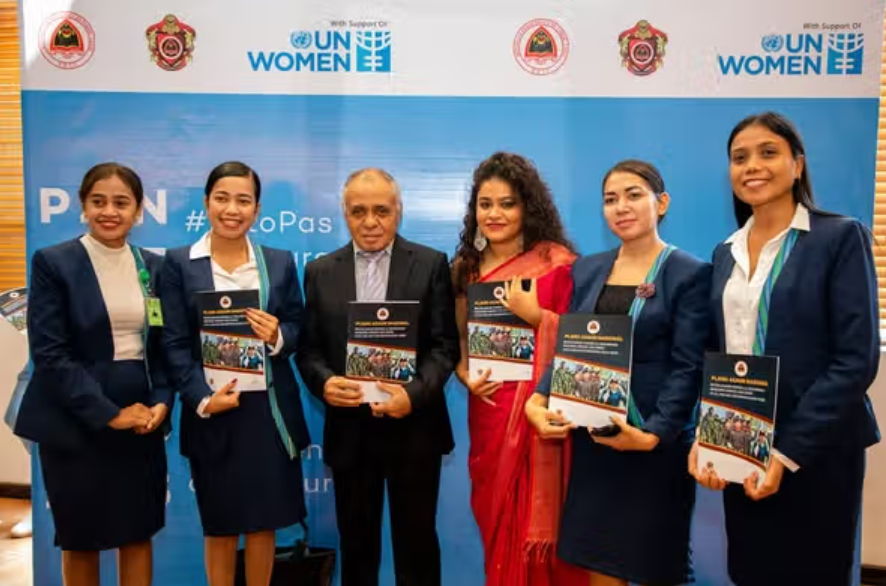 The Government of Timor-Leste adopted the second National Action Plan 1325 on Women, Peace, and Security (NAP 1325) for the period 2024–2028 on 10 January 2024. The official launch ceremony, jointly hosted by the Ministry of Interior (MOI) with the support of UN Women, took place on 16 February 2024.The adoption of second NAP 1325 also demonstrates Government’s commitment to ASEAN Road Map where enhancing women’s participation in peace and rehabilitation processes is a key area of work.
The NAP 1325 contributes directly to several Sustainable Development Goals (SDGs) particularly to SDG 5, 10, 11, 13 and 16. SDG 5:By directly addressing women's participation in leadership roles, combating gender-based violence, and promoting equal access to economic opportunities. SDG 10:By advocating for the inclusion of marginalized women and girls in peacebuilding processes. SDG 16: By promoting women's participation in peace negotiations and conflict resolution mechanisms. SDG 11:By addressing the specific needs of women and girls in urban settings during conflict and post-conflict situations. SDG 13:By integrating gender perspectives into climate change mitigation and adaptation strategies.
The Timor-Leste Country Office (TLCO) played a pivotal role in the development and eventual adoption of the second NAP 1325. TLCO provided technical support to the MOI throughout the process which included capacity development of the key stakeholders, national consultations, drafting the NAP and validation workshops to finalise the NAP. It also supported the establishment of a technical NAP drafting team comprising government advisors, consultants, and experts. TLCO also ensured that the second NAP 1325 aligns closely with two sets of standards, Security Council resolution 1325, the Convention on the Elimination of All Forms of Discrimination Against Women (CEDAW) and the Beijing Platform for Action.
MoI ensured a participatory and inclusive process; ensuring CSOs fully engage in the development process, and their voices, needs, and concerns were reflected in the second NAP, thereby ensuring shared ownership of the NAP at the local level. With TLCO’s facilitation of participatory and inclusive consultations, 15 government institutions and 14 civil society organizations (CSOs), including traditional leaders, faith-based groups, women’s groups, rural women, women with disabilities, survivors of past conflicts, and people with disabilities participated in the process.
MOI also led the development of a Monitoring and Evaluation (M&E) framework to track the progress of NAP 1325. TLCO supported MOI in designing tools and identifying key indicators, data collection methodologies, and institutional responsibilities. The LM-CSO Workshop held by MoI with TLCO’s support in August 2024, provided a platform for finalizing M&E components for the NAP, ensuring robust accountability mechanisms.