SP Result Detail SP_D_1 - Governance and participation in public life (SP_D_1) in 2025

Pacific Women Lead Intergenerational Dialogue to Advance Political Participation
Strategic Note brochure Türkiye 2026-2030
Published on:The UN Women Türkiye Strategic Note 2026–2030 is a costed, results-driven roadmap to advance the rights and empowerment of all women and girls in Türkiye, translating national commitments into real change in women's daily lives. Developed in consultation with national institutions, civil society, and partners, it is aligned with the UNSDCF 2026–2030, UN Women's Global Strategic Plan 2026–2029, and Türkiye's national gender equality priorities. Delivered through UN Women's triple mandate of normative support, UN system coordination, and operational work, the Strategic Note drives change along three interconnected pathways: norms, laws and policies that uphold women's rights; institutions that are accountable through financing, data and practices; and women's agency, leadership, and access to quality services, resources and assets. The Strategic Note is funded through a combination of core (loosely earmarked) and non-core (earmarked) resources, and partnerships that invest in lasting, systemic change.
Strategic Note brochure Ethiopia 2026-2030
Published on:The Strategic Note (SN) articulates the multi-year strategy, rationale, envisioned results, targets, and resource requirements for a UN Women Office. In essence, the SN provides a roadmap for improving the lives of women and girls in the context where UN Women operates. It is developed in consultation with key partners and in alignment with the United Nations Sustainable Development Cooperation Framework (UNSDCF), UN Women’s Strategic Plan and key national, regional, and global gender equality priorities. SNs are funded by a combination of core (loosely earmarked) and non-core resources (earmarked).
Strategic Note brochure Somalia 2026-2030
Published on:The UN Women Strategic Note (SN) 2026–2030 sets out the Office’s multi‑year roadmap for advancing gender equality and women’s empowerment in Somalia. Informed by extensive consultations with government institutions, women‐led organizations, civil society, UN partners, and development actors, the Strategic Note aligns with the UN Sustainable Development Cooperation Framework (2026–2030), UN Women’s Strategic Plan (2026–2029), and Somalia’s national transformative plan and gender equality priorities. It articulates the strategic direction, results focus, and partnerships through which UN Women will contribute to improving the lived realities of women and girls over the SN period.
Strategic Note brochure Rwanda 2026-2029
Published on:The Strategic Note (SN) articulates the multi-year strategy, rationale, envisioned results, targets, and resource requirements for a UN Women Office. In essence, the SN provides a roadmap for improving the lives of women and girls in the context where UN Women operates. It is developed in consultation with key partners and in alignment with the United Nations Sustainable Development Cooperation Framework (UNSDCF), UN Women’s Strategic Plan and key national, regional, and global gender equality priorities. SNs are funded by a combination of core (loosely earmarked) and non-core resources (earmarked).
UN Women’s Affirmative Procurement Regional Initiative in West and Central Africa
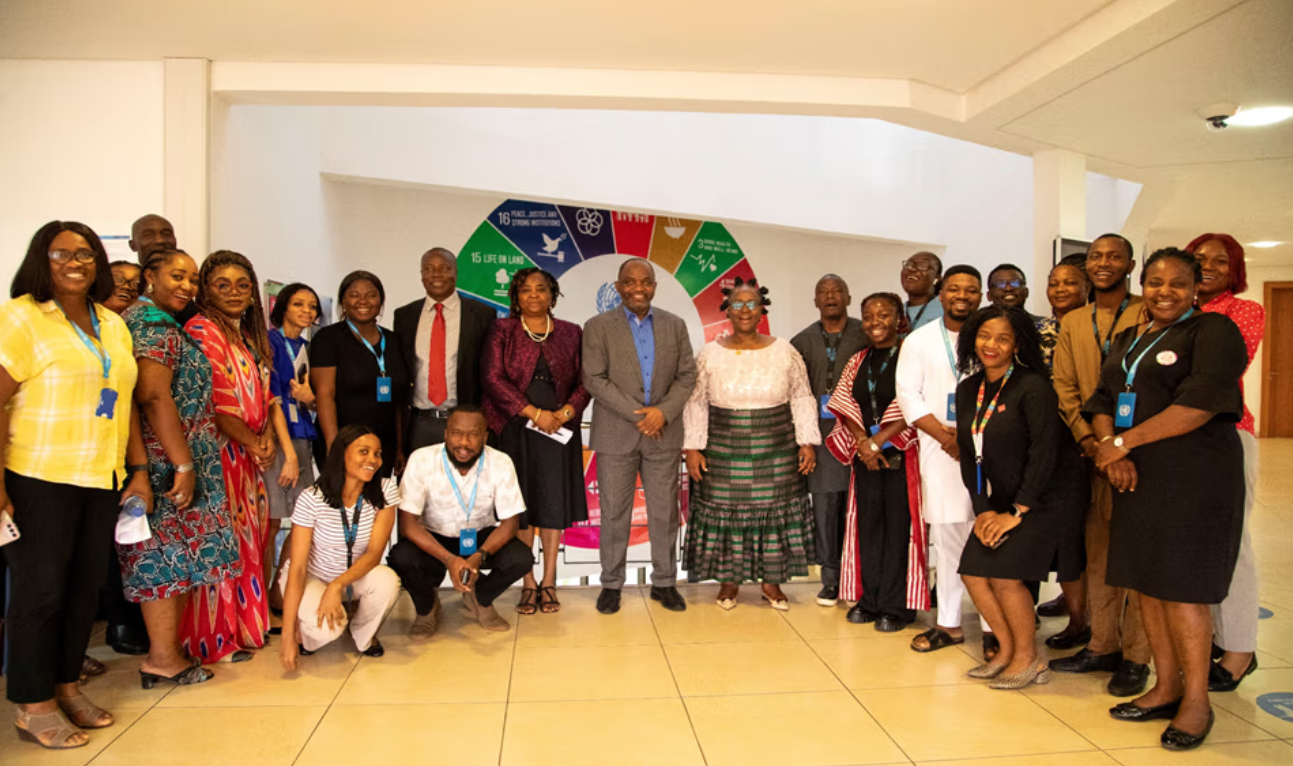 UN Women’s Affirmative Procurement Regional Initiative, funded by the African Development Fund and We-fi (Women Entrepreneurs Financing Facility) has helped improve the abilities of women entrepreneurs and business operations of 1,035 women-led SMEs through targeted training in procurement processes, digital skills, and financial management in across Nigeria, Senegal, Cote d’Ivoire and Mali. Of these, 659 women-led SMEs secured new contracts across public and private sectors, and 245 registered on the UN Global Marketplace (UNGM) platform. They can therefore, access procurement contracts with the UN system in the future. Over 1,700 women entrepreneurs in the four countries are equipped to navigate procurement processes and apply for public bids.
The Affirmative Procurement Initiative is fully aligned with the UN Women Strategic Plan, and tackles root causes and capacity gaps. Its results-focused approach is rendering changes in translating the dynamic set of global gender equality and empowerment norms and standards gender-responsive laws. It also enabled more women entrepreneurs in West and Central Africa to get equitable access to high-quality public goods, services, jobs, and resources that are responsive to their needs.
In 2024, Kaduna State in Nigeria, home to 9 million people, adopted groundbreaking legislation to give women preferential access to public contracts, thanks to UN Women’s support through the regional Project on Affirmative Procurement Reform in West Africa. This important normative landmark outcome advances women’s economic empowerment in West and Central Africa and directly contributes to Sustainable Development Goal 5 (Gender Equality) and Goal 8 (Decent Work and Economic Growth). The Affirmative Procurement Act, adopted, allows women-led businesses to bid even if they do not yet satisfy the prior registration requirement and provides for the minimum allocation of 5 to 20% of the market to them, depending on the type of bid.
Timor-Leste adopts the 2nd National Action Plan 1325
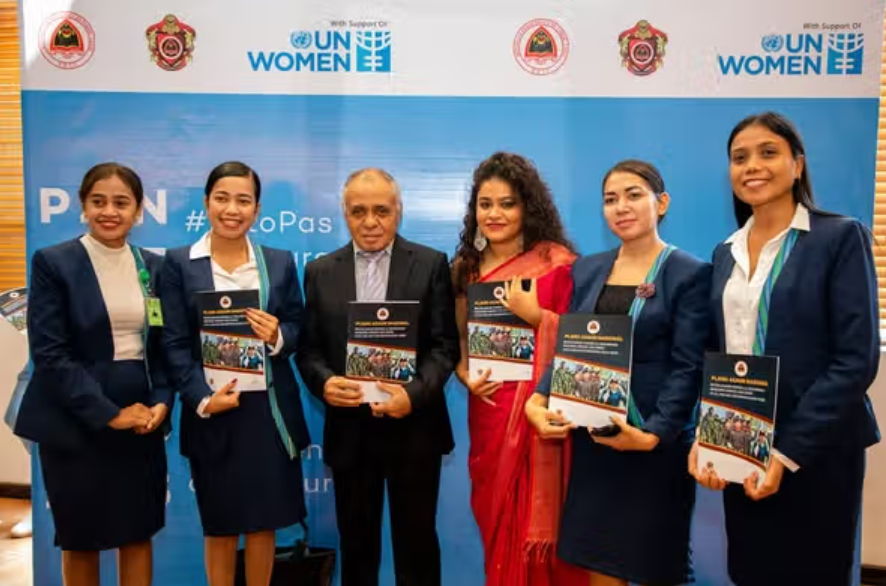 The Government of Timor-Leste adopted the second National Action Plan 1325 on Women, Peace, and Security (NAP 1325) for the period 2024–2028 on 10 January 2024. The official launch ceremony, jointly hosted by the Ministry of Interior (MOI) with the support of UN Women, took place on 16 February 2024.The adoption of second NAP 1325 also demonstrates Government’s commitment to ASEAN Road Map where enhancing women’s participation in peace and rehabilitation processes is a key area of work.
The NAP 1325 contributes directly to several Sustainable Development Goals (SDGs) particularly to SDG 5, 10, 11, 13 and 16. SDG 5:By directly addressing women's participation in leadership roles, combating gender-based violence, and promoting equal access to economic opportunities. SDG 10:By advocating for the inclusion of marginalized women and girls in peacebuilding processes. SDG 16: By promoting women's participation in peace negotiations and conflict resolution mechanisms. SDG 11:By addressing the specific needs of women and girls in urban settings during conflict and post-conflict situations. SDG 13:By integrating gender perspectives into climate change mitigation and adaptation strategies.
The Timor-Leste Country Office (TLCO) played a pivotal role in the development and eventual adoption of the second NAP 1325. TLCO provided technical support to the MOI throughout the process which included capacity development of the key stakeholders, national consultations, drafting the NAP and validation workshops to finalise the NAP. It also supported the establishment of a technical NAP drafting team comprising government advisors, consultants, and experts. TLCO also ensured that the second NAP 1325 aligns closely with two sets of standards, Security Council resolution 1325, the Convention on the Elimination of All Forms of Discrimination Against Women (CEDAW) and the Beijing Platform for Action.
MoI ensured a participatory and inclusive process; ensuring CSOs fully engage in the development process, and their voices, needs, and concerns were reflected in the second NAP, thereby ensuring shared ownership of the NAP at the local level. With TLCO’s facilitation of participatory and inclusive consultations, 15 government institutions and 14 civil society organizations (CSOs), including traditional leaders, faith-based groups, women’s groups, rural women, women with disabilities, survivors of past conflicts, and people with disabilities participated in the process.
MOI also led the development of a Monitoring and Evaluation (M&E) framework to track the progress of NAP 1325. TLCO supported MOI in designing tools and identifying key indicators, data collection methodologies, and institutional responsibilities. The LM-CSO Workshop held by MoI with TLCO’s support in August 2024, provided a platform for finalizing M&E components for the NAP, ensuring robust accountability mechanisms.
Towards a just future: enhancing women’s political leadership and participation in security decision-making
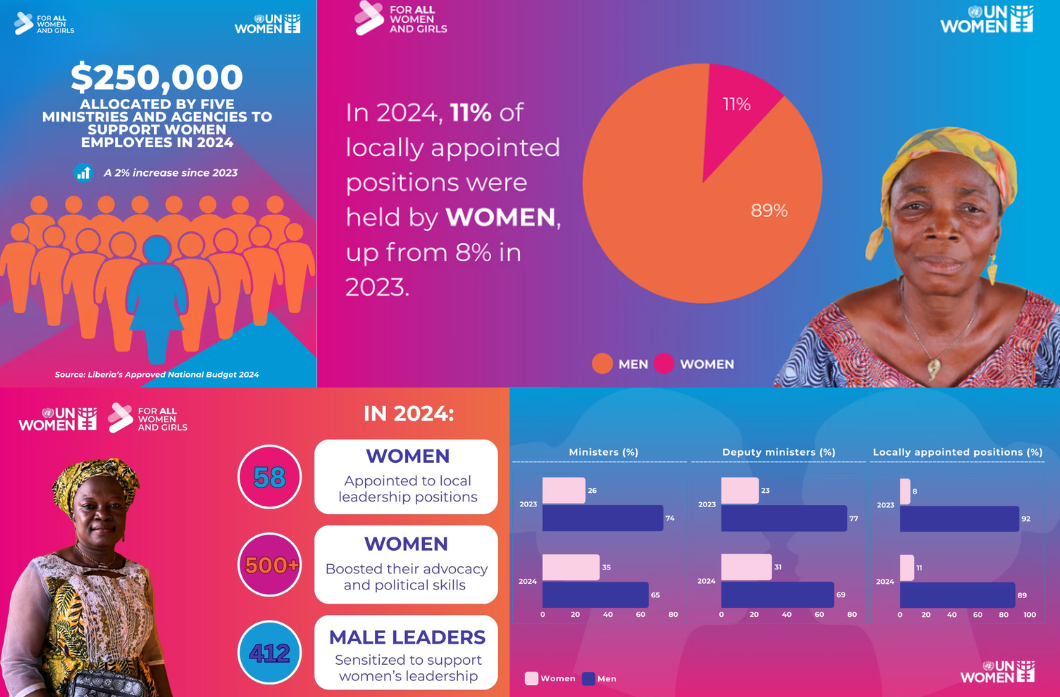
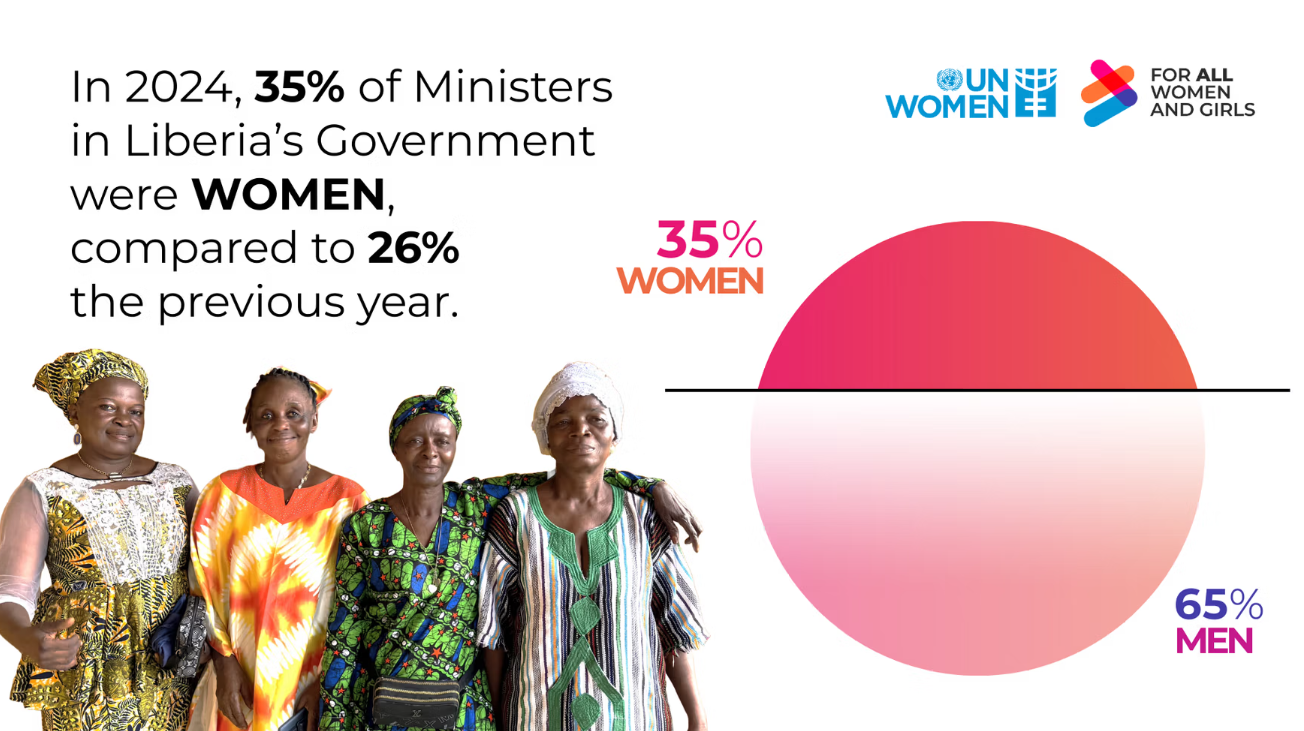 UN Women’s partnership with the Government of Liberia has driven meaningful progress in women’s political leadership and participation in security decision-making, contributing to SDG 5 (Gender Equality), SDG 16 (Peace, Justice, and Strong Institutions) and Outcomes 3 and 4 of the United Nations Sustainable Development Cooperation Framework (Sustaining Peace and Security; Governance and Transparency). In 2024, women were appointed as Minister of National Defense and Spokesperson for the Liberia National Police for the first time. While the security sector remains male-dominated, these milestones reflect UN Women’s contribution through sustained advocacy and programming to increase the number of women in military and police roles. Moreover, women's representation in the ministerial cabinet increased from 26.3 percent in 2023 to 35 percent in 2024, while the share of women deputy ministers rose from 23 percent to 31 percent. At the local level, women now hold 11 percent of appointed positions, up from 8 percent in 2023.
UN Women facilitated these achievements by collaborating with local women’s rights organizations, such as Sister Aid Liberia and the Women’s NGO Secretariat of Liberia, to enhance the advocacy and political leadership skills of over 500 women. This entailed providing evidence-based tools to support their engagement with decision-makers, leading to the targeting of 412 male leaders, including traditional leaders across seven counties[1], to actively support women’s participation. This positively influenced men's roles in promoting gender parity and contributed to 58 women being appointed to local leadership roles, including town chiefs and district commissioners, thereby increasing women's representation in local governance. These results align with increased funding to support women's meaningful participation in public life. In 2024, five[2] ministries and agencies, including one security institution, allocated over $250,000—a 2 percent increase from 2023—to better support their women employees.
With funding from the Governments of Ireland, Sweden, UNDP, and the UN Peacebuilding Fund, UN Women is advancing transformative approaches with the potential to create a more just, equal future for women and girls in Liberia.