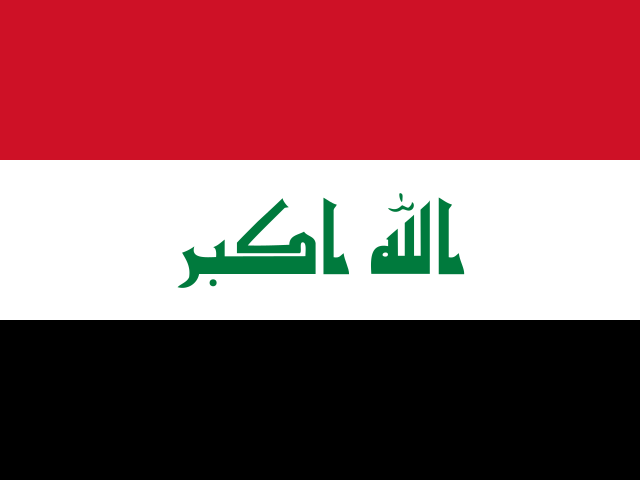
 Iraq
Iraq
Other resources (non-core)
Country Indexes
UN Women in action: Strategic insights and achievements
View annual report narratives for the year
Advancing SDGs: UN Women's impact and key achievements
In 2025, UN Women played a central role in strengthening Iraq's national systems to support women's participation in political life and advance Women, Peace and Security commitments. Through sustained technical partnership with key government institutions including the National Directorate for Iraqi Women, the High Council for Women and Development, and the Higher Committee for Supporting Women in Elections. UN Women contributed to building more structured and coordinated pathways for women to engage in decision-making and peacebuilding processes, creating safer and more enabling conditions for women candidates, women leaders, and women at community level to participate in public life.
A key achievement was the development and operationalization of a national framework on women's political participation ahead of the 2025 parliamentary elections. With UN Women's technical guidance, the framework was adopted by the Higher Committee for Supporting Women in Elections as the primary national coordination platform guiding institutional engagement on women's participation and prevention of violence against women in politics marking a shift from ad hoc support to a government-owned, nationally led coordination architecture. Building on this framework, 110 national trainers were capacitated through two government-led Training of Trainers initiatives, reaching women candidates and women's political party structures across all governorates, with violence against women in politics, digital safety, and campaign skills systematically integrated into all training tracks.
In parallel, Iraq’s Third National Action Plan on UN Security Council Resolution 1325 was finalized and launched, with technical support from UN Women. In the Kurdistan Region of Iraq, the High Council for Women and Development launched the Regional Action Plan on Women, Peace and Security (2025–2030), reinforcing implementation of WPS commitments at regional level.
UN Women served as the main technical partner to government institutions throughout these processes. This included providing strategic guidance, recruiting and supporting technical experts, facilitating consultations with women and civil society actors, reviewing and strengthening draft frameworks, and ensuring alignment with national and international gender equality commitments. Close coordination with national institutions and UN partners helped consolidate ownership and coherence.
While institutional reforms require sustained implementation to translate into long-term impact, the establishment and activation of these frameworks represent concrete structural progress toward strengthening women’s leadership, protection, and participation in Iraq, advancing SDGs 5 and 16.
A key achievement was the development and operationalization of a national framework on women's political participation ahead of the 2025 parliamentary elections. With UN Women's technical guidance, the framework was adopted by the Higher Committee for Supporting Women in Elections as the primary national coordination platform guiding institutional engagement on women's participation and prevention of violence against women in politics marking a shift from ad hoc support to a government-owned, nationally led coordination architecture. Building on this framework, 110 national trainers were capacitated through two government-led Training of Trainers initiatives, reaching women candidates and women's political party structures across all governorates, with violence against women in politics, digital safety, and campaign skills systematically integrated into all training tracks.
In parallel, Iraq’s Third National Action Plan on UN Security Council Resolution 1325 was finalized and launched, with technical support from UN Women. In the Kurdistan Region of Iraq, the High Council for Women and Development launched the Regional Action Plan on Women, Peace and Security (2025–2030), reinforcing implementation of WPS commitments at regional level.
UN Women served as the main technical partner to government institutions throughout these processes. This included providing strategic guidance, recruiting and supporting technical experts, facilitating consultations with women and civil society actors, reviewing and strengthening draft frameworks, and ensuring alignment with national and international gender equality commitments. Close coordination with national institutions and UN partners helped consolidate ownership and coherence.
While institutional reforms require sustained implementation to translate into long-term impact, the establishment and activation of these frameworks represent concrete structural progress toward strengthening women’s leadership, protection, and participation in Iraq, advancing SDGs 5 and 16.
Advancing SDGs: UN Women's impact and key achievements
UN Women Iraq’s most significant progress in 2024 was strengthening partnerships with the Government of Iraq to stabilize and drive gender equality and inclusive governance. By overcoming challenges in coordination and fostering trust with key government entities, UN Women established a solid foundation for collaborative efforts toward achieving SDG 5 (Gender Equality) and SDG 16 (Peace, Justice, and Strong Institutions). Strengthened partnerships with the National Directorate for Iraqi Women (NDIW) in Baghdad and enhanced collaboration with other national counterparts ensured more effective support for institutional frameworks promoting women’s empowerment.
Iraq developed its third National Action Plan (INAP III) on Women, Peace, and Security. This plan integrated lessons learned from previous plans and enhanced coordination mechanisms. UN Women supported the development of the INAP III by supporting consultations around the development of the new INAP III. This support included contracting a consultant under NDIW, who worked closely with line ministries and stakeholders to draft the initial version. As part of this process, the consultant conducted meetings and stakeholder interviews to gather information and populate the INAP draft. This was followed by broader consultations with the government, civil society organizations, and line ministries to refine and finalize the INAP III.
Through Women Peace and Security support on peacebuilding, women in Iraq could join the country’s first National Women’s Mediators Network. Through the Network, women gained conflict resolution skills to actively participate in national and local peace processes.
These achievements were complemented by initiatives that reinforced gender equality advocacy and institutional capacity. UN Women facilitated key events, including International Women’s Day and the 16 Days of Activism, amplifying awareness on critical issues affecting women and girls. UN Women also continued its leadership role in coordinating gender-responsive governance through workshops, consultations, and operational support to key government initiatives.
By stabilizing and strengthening partnerships, addressing challenges, and aligning national priorities with international frameworks, UN Women laid a robust foundation for sustained progress in advancing gender equality and inclusive governance in Iraq
Iraq developed its third National Action Plan (INAP III) on Women, Peace, and Security. This plan integrated lessons learned from previous plans and enhanced coordination mechanisms. UN Women supported the development of the INAP III by supporting consultations around the development of the new INAP III. This support included contracting a consultant under NDIW, who worked closely with line ministries and stakeholders to draft the initial version. As part of this process, the consultant conducted meetings and stakeholder interviews to gather information and populate the INAP draft. This was followed by broader consultations with the government, civil society organizations, and line ministries to refine and finalize the INAP III.
Through Women Peace and Security support on peacebuilding, women in Iraq could join the country’s first National Women’s Mediators Network. Through the Network, women gained conflict resolution skills to actively participate in national and local peace processes.
These achievements were complemented by initiatives that reinforced gender equality advocacy and institutional capacity. UN Women facilitated key events, including International Women’s Day and the 16 Days of Activism, amplifying awareness on critical issues affecting women and girls. UN Women also continued its leadership role in coordinating gender-responsive governance through workshops, consultations, and operational support to key government initiatives.
By stabilizing and strengthening partnerships, addressing challenges, and aligning national priorities with international frameworks, UN Women laid a robust foundation for sustained progress in advancing gender equality and inclusive governance in Iraq
Advancing SDGs: UN Women's impact and key achievements
In 2023, UN Women's programming and impact was evident in a number of propogrammes and activities, including WPP, WEE, WPS and EVAW. Through this programing which included economic and social empowerment of vulnerable women and girls, UN Women's work directly contributed to SDG 5 (Gender Equality).
On the 18th of December 2023, Iraq held provincial council elections, amidst ongoing challenges and political instability between established political class and groups seeking to challenge. Provincial council elections hold extraordinary power in Iraq as such councils wield financial legislative and executive powers in their localities, especially given the fact that they are not subject to supervision of ministries. This includes broad administrative powers and an independent financial system. Elected members of these councils will in turn select governors and form local governments, making supporting women’s representation essential. The elections also hold a special importance as they were last held more than 10 years ago and had suffered significant delays.
As such, in 2023 UNWomen Iraq supported the provincial elections through a number of high level activities, including holding coordination efforts with key stakeholders such as the High Electoral Commission, Parliamentary committees, and other governmental counterparts. This resulted in the development of a Women’s Political Participation workplan for the elections, as well as raising the issue at the highest level. Additionally UN Women Iraq trained a number of female candidates and aspirants looking to run for provincial elections.
In addition UN Women Iraq worked in 2023 through sustainable partnerships which included civil society organizations and governmental entities. Most significantly, UNW programing successfully contributed to support national women machineries and address structural barriers by focusing on economic opportunities, governance advancements, community support, violence against women, and women’s leadership and political participation.
On the 18th of December 2023, Iraq held provincial council elections, amidst ongoing challenges and political instability between established political class and groups seeking to challenge. Provincial council elections hold extraordinary power in Iraq as such councils wield financial legislative and executive powers in their localities, especially given the fact that they are not subject to supervision of ministries. This includes broad administrative powers and an independent financial system. Elected members of these councils will in turn select governors and form local governments, making supporting women’s representation essential. The elections also hold a special importance as they were last held more than 10 years ago and had suffered significant delays.
As such, in 2023 UNWomen Iraq supported the provincial elections through a number of high level activities, including holding coordination efforts with key stakeholders such as the High Electoral Commission, Parliamentary committees, and other governmental counterparts. This resulted in the development of a Women’s Political Participation workplan for the elections, as well as raising the issue at the highest level. Additionally UN Women Iraq trained a number of female candidates and aspirants looking to run for provincial elections.
In addition UN Women Iraq worked in 2023 through sustainable partnerships which included civil society organizations and governmental entities. Most significantly, UNW programing successfully contributed to support national women machineries and address structural barriers by focusing on economic opportunities, governance advancements, community support, violence against women, and women’s leadership and political participation.
Advancing SDGs: UN Women's impact and key achievements
Interaction and collaboration between CSOs and the Government was enhanced in the context of leveraging national policies and frameworks focused on achieving and monitoring SDG n.5 “Achieve gender equality and empower all women and girls”, SDG n.16 “Promote peaceful and inclusive societies for sustainable development, provide access to justice for all and build effective, accountable and inclusive institutions at all levels”, and global norms on GEWE. UN Women interventions and results directly contributed to achieving Iraq UNSDCF Strategic Priority (SP) Area 1 (“Achieving social cohesion, protection and inclusion”) and in particular UNSDCF Outcomes 8.1, 8.2 and 8.3. Specifically, the development and implementation of national plans (Iraq second National Action Plan for the implementation of UNSCR 1325 - II INAP 1325; the National Strategy for the Enhancement of the Status of Iraqi Women 2019/2023 and the Strategy for the High Council of Women’s Affairs in KRG 2019/2022), was supported by UN Women through a multi-pronged approach that included: (i) strengthening coordination mechanisms among governmental actors - at the Federal and Kurdistan levels - and civil society; (ii) establishing and operationalizing accountability frameworks; and (iii) initiating the elaboration of INAP II sectorial ministerial plans. Local partners contributed towards SDG 5 and SDG 16 as well as SDGs 1, 3, 4 and 8, leveraging CEDAW General Recommendation No 30 and 2030 Agenda with its focus on “Leaving no woman or girl behind” as key guiding frameworks. This support was provided in the context of UN Women’s programmatic interventions focused on (i) Women’s Political Participation, (ii) Women Peace and Security (WPS), and (iii) Protection and Promotion of Women and Girls’ Rights, and Ending Violence Against Women (EVAW). At the UN System level, planning, monitoring and communication tools contributed to provide updated information and measure progress towards the achievement of the SDGs, namely: (i) gender equality was effectively mainstreamed in UNSDCF implementation, and UNSDCF indicators contributed to measure changes on gender equality; (ii) communication and advocacy efforts addressed areas of gender inequality in Iraq, and (iii) UN Gender Task Force (chaired by UN Women) was empowered and better coordinated to influence the UNCT for the promotion of gender quality and empowerment of women in Iraq.
Results and resources
- Results overview
- Total resources
- Development results and resources
- Organizational results and resources
Budget
Expenses
Outcome
Result statement
IATI identifier
Budget
Expenses
Outcome
Result statement
IATI identifier
OutcomeIRQ_O_1
Outcome result statementUN Women is an accountable and trustworthy development organization that manages its financial and other resources with integrity and in line with its programmatic ambitions and fiduciary obligations.
IATI identifierXM-DAC-41146-IRQ_O_1
OutcomeIRQ_O_2
Outcome result statementUN-Women effectively leverages and expands its partnerships, communications and advocacy capabilities to increase support for and financing of the gender equality agenda, while securing sustainable resourcing for the delivery of its own mandate.
IATI identifierXM-DAC-41146-IRQ_O_2
OutcomeIRQ_O_3
Outcome result statementUN Women delivers impact at scale, through agile and ethical leadership rooted in a continuous improvement culture
IATI identifierXM-DAC-41146-IRQ_O_3
OutcomeIRQ_O_4
Outcome result statementUNWomen is regarded as an employer of choice with a diverse and highly performing cadre of personnel that embodies UN values.
IATI identifierXM-DAC-41146-IRQ_O_4
OutcomeIRQ_O_5
Outcome result statementUN Women efficiently and effectively discharges of all business processes that advance integrated delivery of its normative, operational and coordination mandate at HQ, Regional and Country level, including through shared services.
IATI identifierXM-DAC-41146-IRQ_O_5
Resources allocated towards SDGs
View SDG data for
Our funding partners contributions
- Chart
- Table
Regular resources (core)
$138.34 K in total
Lorem Ipsum is simply dummy text of the printing and typesetting industry.
Other resources (non-core)
$13.27 M in total
Regular resources (core)
$138.34 K in total
Lorem Ipsum is simply dummy text of the printing and typesetting industry.
| 2023 | 2022 | 2021 | 2020 | 2019 | |
|---|---|---|---|---|---|
| United Nations Entity for Gender Equality and the Empowerment of Women (UN Women) | $6,669 2023
United Nations Entity for Gender Equality and the Empowerment of Women (UN Women)
Total contribution:$6,669
Development:$6,669(100%)
Humanitarian:$0(0%)
|
$6,669 2022
United Nations Entity for Gender Equality and the Empowerment of Women (UN Women)
Total contribution:$6,669
Development:$6,669(100%)
Humanitarian:$0(0%)
|
--
2021
No data available
|
--
2020
No data available
|
$125,000 2019
United Nations Entity for Gender Equality and the Empowerment of Women (UN Women)
Total contribution:$125,000
Development:$125,000(100%)
Humanitarian:$0(0%)
|
2023
United Nations Entity for Gender Equality and the Empowerment of Women (UN Women)$6,669
Total contribution$6,669
Development$6,669(100%)
Humanitarian$0(0%)
2022
United Nations Entity for Gender Equality and the Empowerment of Women (UN Women)$6,669
Total contribution$6,669
Development$6,669(100%)
Humanitarian$0(0%)
2019
United Nations Entity for Gender Equality and the Empowerment of Women (UN Women)$125,000
Total contribution$125,000
Development$125,000(100%)
Humanitarian$0(0%)
Other resources (non-core)
$13.27 M in total
Lorem Ipsum is simply dummy text of the printing and typesetting industry.
| 2023 | 2022 | 2021 | 2020 | 2019 | |
|---|---|---|---|---|---|
| European Commission | --
2023
No data available
|
--
2022
No data available
|
$87,307 2021
European CommissionOECD-DAC donor
Total contribution:$87,307
Development:$87,307(100%)
Humanitarian:$0(0%)
|
$352,862 2020
European CommissionOECD-DAC donor
Total contribution:$352,862
Development:$352,862(100%)
Humanitarian:$0(0%)
|
$2,215,909 2019
European CommissionOECD-DAC donor
Total contribution:$2,215,909
Development:$2,215,909(100%)
Humanitarian:$0(0%)
|
| Finland | $395,230 2023
FinlandOECD-DAC donor
Total contribution:$395,230
Development:$395,230(100%)
Humanitarian:$0(0%)
|
$395,230 2022
FinlandOECD-DAC donor
Total contribution:$395,230
Development:$395,230(100%)
Humanitarian:$0(0%)
|
$348,462 2021
FinlandOECD-DAC donor
Total contribution:$348,462
Development:$348,462(100%)
Humanitarian:$0(0%)
|
$291,547 2020
FinlandOECD-DAC donor
Total contribution:$291,547
Development:$291,547(100%)
Humanitarian:$0(0%)
|
$221,315 2019
FinlandOECD-DAC donor
Total contribution:$221,315
Development:$221,315(100%)
Humanitarian:$0(0%)
|
| Germany | --
2023
No data available
|
--
2022
No data available
|
--
2021
No data available
|
--
2020
No data available
|
$889,192 2019
GermanyOECD-DAC donor
Total contribution:$889,192
Development:$889,192(100%)
Humanitarian:$0(0%)
|
| Japan | $274,729 2023
JapanOECD-DAC donor
Total contribution:$274,729
Development:$274,729(100%)
Humanitarian:$0(0%)
|
$274,729 2022
JapanOECD-DAC donor
Total contribution:$274,729
Development:$274,729(100%)
Humanitarian:$0(0%)
|
$928,954 2021
JapanOECD-DAC donor
Total contribution:$928,954
Development:$928,954(100%)
Humanitarian:$0(0%)
|
$766,859 2020
JapanOECD-DAC donor
Total contribution:$766,859
Development:$766,859(100%)
Humanitarian:$0(0%)
|
$288,388 2019
JapanOECD-DAC donor
Total contribution:$288,388
Development:$288,388(100%)
Humanitarian:$0(0%)
|
| United States of America | --
2023
No data available
|
--
2022
No data available
|
--
2021
No data available
|
$561,134 2020
United States of AmericaOECD-DAC donor
Total contribution:$561,134
Development:$561,134(100%)
Humanitarian:$0(0%)
|
$375,849 2019
United States of AmericaOECD-DAC donor
Total contribution:$375,849
Development:$375,849(100%)
Humanitarian:$0(0%)
|
| United Nations Multi-Partner Trust Fund Office | $646,945 2023
United Nations Multi-Partner Trust Fund OfficeUnited Nations pooled fund
Total contribution:$646,945
Development:$646,945(100%)
Humanitarian:$0(0%)
|
$646,945 2022
United Nations Multi-Partner Trust Fund OfficeUnited Nations pooled fund
Total contribution:$646,945
Development:$646,945(100%)
Humanitarian:$0(0%)
|
$198,765 2021
United Nations Multi-Partner Trust Fund OfficeUnited Nations pooled fund
Total contribution:$198,765
Development:$198,765(100%)
Humanitarian:$0(0%)
|
$370,000 2020
United Nations Multi-Partner Trust Fund OfficeUnited Nations pooled fund
Total contribution:$370,000
Development:$370,000(100%)
Humanitarian:$0(0%)
|
--
2019
No data available
|
| Sweden | $536,334 2023
SwedenOECD-DAC donor
Total contribution:$536,334
Development:$536,334(100%)
Humanitarian:$0(0%)
|
$536,334 2022
SwedenOECD-DAC donor
Total contribution:$536,334
Development:$536,334(100%)
Humanitarian:$0(0%)
|
$23,040 2021
SwedenOECD-DAC donor
Total contribution:$23,040
Development:$23,040(100%)
Humanitarian:$0(0%)
|
--
2020
No data available
|
--
2019
No data available
|
| Iceland National Committee | $60,490 2023
Iceland National CommitteeNational Committee
Total contribution:$60,490
Development:$60,490(100%)
Humanitarian:$0(0%)
|
$60,490 2022
Iceland National CommitteeNational Committee
Total contribution:$60,490
Development:$60,490(100%)
Humanitarian:$0(0%)
|
--
2021
No data available
|
--
2020
No data available
|
--
2019
No data available
|
| Italy | $760,952 2023
ItalyOECD-DAC donor
Total contribution:$760,952
Development:$760,952(100%)
Humanitarian:$0(0%)
|
$760,952 2022
ItalyOECD-DAC donor
Total contribution:$760,952
Development:$760,952(100%)
Humanitarian:$0(0%)
|
--
2021
No data available
|
--
2020
No data available
|
--
2019
No data available
|
2023
Finland$395,230
Total contribution$395,230
Development$395,230(100%)
Humanitarian$0(0%)
Japan$274,729
Total contribution$274,729
Development$274,729(100%)
Humanitarian$0(0%)
United Nations Multi-Partner Trust Fund Office$646,945
Total contribution$646,945
Development$646,945(100%)
Humanitarian$0(0%)
Sweden$536,334
Total contribution$536,334
Development$536,334(100%)
Humanitarian$0(0%)
Iceland National Committee$60,490
Total contribution$60,490
Development$60,490(100%)
Humanitarian$0(0%)
Italy$760,952
Total contribution$760,952
Development$760,952(100%)
Humanitarian$0(0%)
2022
Finland$395,230
Total contribution$395,230
Development$395,230(100%)
Humanitarian$0(0%)
Japan$274,729
Total contribution$274,729
Development$274,729(100%)
Humanitarian$0(0%)
United Nations Multi-Partner Trust Fund Office$646,945
Total contribution$646,945
Development$646,945(100%)
Humanitarian$0(0%)
Sweden$536,334
Total contribution$536,334
Development$536,334(100%)
Humanitarian$0(0%)
Iceland National Committee$60,490
Total contribution$60,490
Development$60,490(100%)
Humanitarian$0(0%)
Italy$760,952
Total contribution$760,952
Development$760,952(100%)
Humanitarian$0(0%)
2021
European Commission$87,307
Total contribution$87,307
Development$87,307(100%)
Humanitarian$0(0%)
Finland$348,462
Total contribution$348,462
Development$348,462(100%)
Humanitarian$0(0%)
Japan$928,954
Total contribution$928,954
Development$928,954(100%)
Humanitarian$0(0%)
United Nations Multi-Partner Trust Fund Office$198,765
Total contribution$198,765
Development$198,765(100%)
Humanitarian$0(0%)
Sweden$23,040
Total contribution$23,040
Development$23,040(100%)
Humanitarian$0(0%)
2020
European Commission$352,862
Total contribution$352,862
Development$352,862(100%)
Humanitarian$0(0%)
Finland$291,547
Total contribution$291,547
Development$291,547(100%)
Humanitarian$0(0%)
Japan$766,859
Total contribution$766,859
Development$766,859(100%)
Humanitarian$0(0%)
United States of America$561,134
Total contribution$561,134
Development$561,134(100%)
Humanitarian$0(0%)
United Nations Multi-Partner Trust Fund Office$370,000
Total contribution$370,000
Development$370,000(100%)
Humanitarian$0(0%)
2019
European Commission$2,215,909
Total contribution$2,215,909
Development$2,215,909(100%)
Humanitarian$0(0%)
Finland$221,315
Total contribution$221,315
Development$221,315(100%)
Humanitarian$0(0%)
Germany$889,192
Total contribution$889,192
Development$889,192(100%)
Humanitarian$0(0%)
Japan$288,388
Total contribution$288,388
Development$288,388(100%)
Humanitarian$0(0%)
United States of America$375,849
Total contribution$375,849
Development$375,849(100%)
Humanitarian$0(0%)